

What Is an Embedded Computer? Types, Components, Applications & Benefits
Table Of Contents
- What Is an Embedded Computer?
- How Does an Embedded Computer Work?
- Main Components of an Embedded Computer
- Types of Embedded Computers
- Embedded System vs General-Purpose Computing System
- Operating Systems and Connectivity
- Applications of Embedded Computers
- What Makes an Industrial Embedded Computer Different?
- Embedded Computers, Edge Computing and AI
- Security in Embedded Computing
- Benefits and Limitations of Embedded Computers
- How to Choose an Embedded Computer
- Conclusion
Embedded computers are the computing engines inside many machines and electronic systems. They control industrial equipment, process data from sensors and cameras, manage vehicle functions, support medical devices and increasingly run artificial intelligence at the edge.
Unlike a desktop or laptop designed for many unrelated tasks, an embedded computer is built or configured to perform a specific function-or a defined group of functions-within a larger system. Depending on the application, it may need to run continuously, respond in real time, operate with limited power or withstand heat, vibration and dust.
This guide explains what an embedded computer is, how it works, its main components and types, how it differs from a general-purpose computer, where it is used and what engineers should consider when selecting one.
Types of Embedded Computers
An embedded computer is a purpose-built computing system integrated into a larger device, machine or electrical system to perform one or more dedicated functions. It typically combines a processor, memory, storage, input/output interfaces and software or firmware.
It may be based on a microcontroller, microprocessor, system-on-chip (SoC), single-board computer (SBC) or complete industrial PC. The architecture depends on the performance, connectivity, environmental and real-time requirements of the application.
A simple embedded computer definition is: a computer designed to monitor, control, process or automate a specific function as part of a larger system.
For example, an embedded computer in a machine-vision system may receive images from industrial cameras, process them using inspection software and send a pass/fail signal to production equipment. In a vehicle, an embedded platform may handle telematics, navigation or onboard video processing.
How Does an Embedded Computer Work?
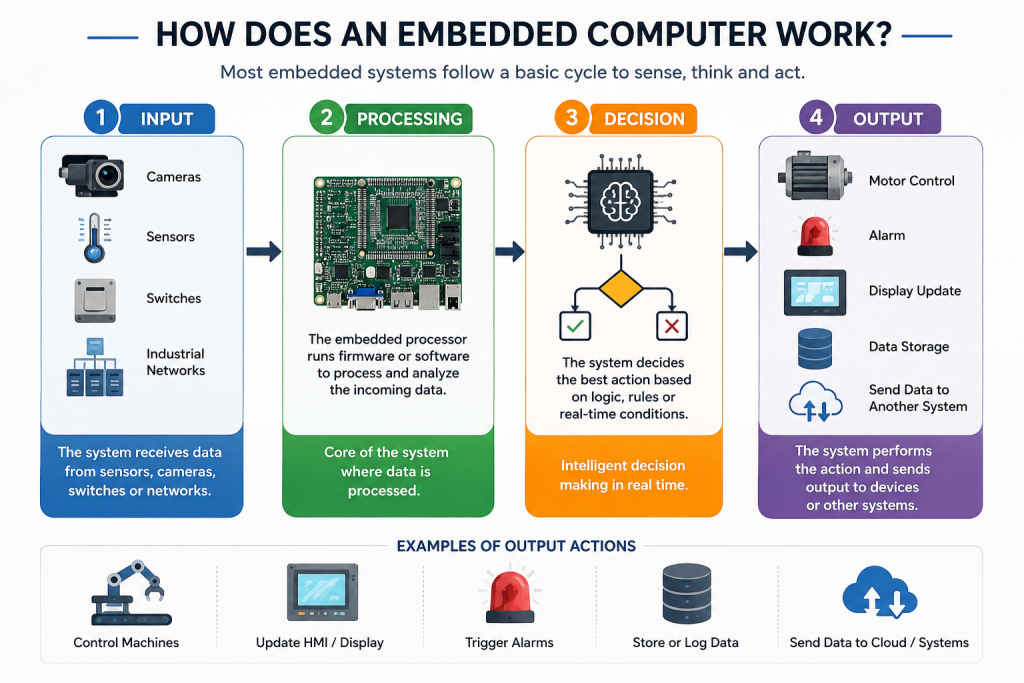
Most embedded systems follow a basic cycle:
Input → Processing → Decision → Output
The system receives input from sensors, cameras, switches, industrial networks or other connected devices. The processor executes firmware or software instructions and analyzes that data. It then generates an output, such as controlling a motor, updating a display, triggering an alarm, storing a record or sending information to another machine.
Some applications also require real-time behavior. In these systems, producing the correct result is not enough-the result must be delivered within a predictable time limit. This is important in motion control, robotics, transportation and industrial automation.
Main Components of an Embedded Computer
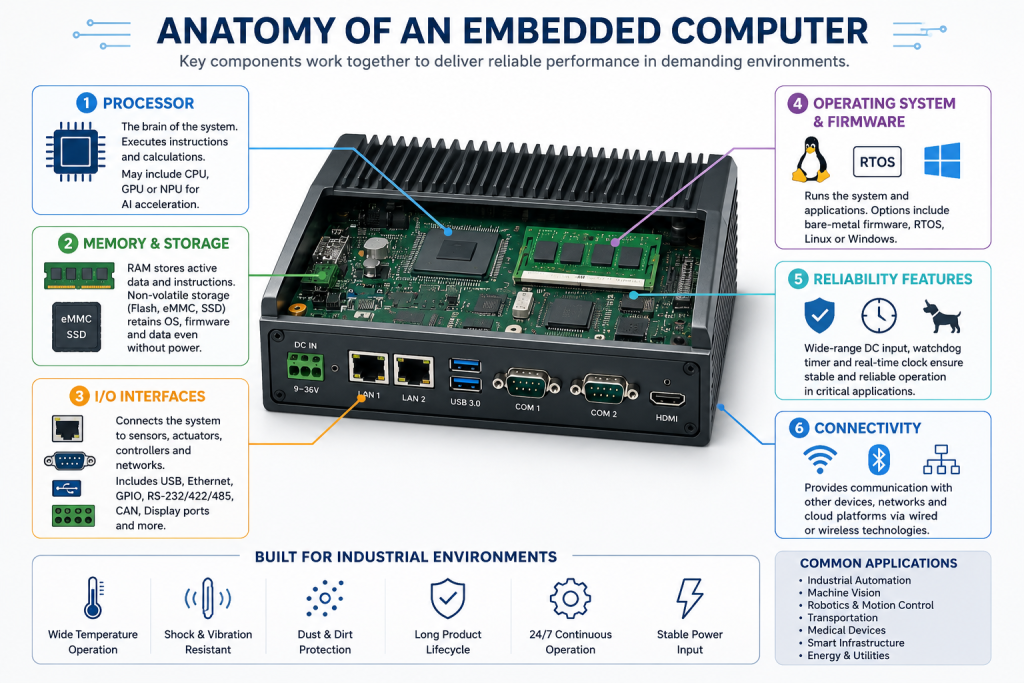
Processor
The processor executes instructions and calculations. Simple systems may use a microcontroller, while demanding applications can use multicore CPUs, SoCs, GPUs or NPUs. Machine vision and edge AI may require hardware acceleration for image processing and AI inference.
Memory and Storage
RAM stores active data and instructions. Non-volatile memory such as flash, eMMC or SSD storage retains firmware, operating systems, applications and data after power is removed. Higher-performance industrial systems may use SATA or NVMe SSDs.
Input/Output Interfaces
I/O connects the embedded computer to sensors, controllers and other equipment. Common interfaces include USB, Ethernet, GPIO, RS-232, RS-422, RS-485, CAN, digital I/O and display connections.
Industrial systems may also communicate with PLCs and remote I/O through protocols such as Modbus.
Firmware and Operating System
A simple controller may run bare-metal firmware, while a more complex embedded computer may use a real-time operating system (RTOS), embedded Linux or Windows-based industrial software.
Reliability Functions
Industrial designs may include wide-range DC input, real-time clocks and watchdog timers. These features help support dependable operation in long-running or demanding applications.
Types of Embedded Computers
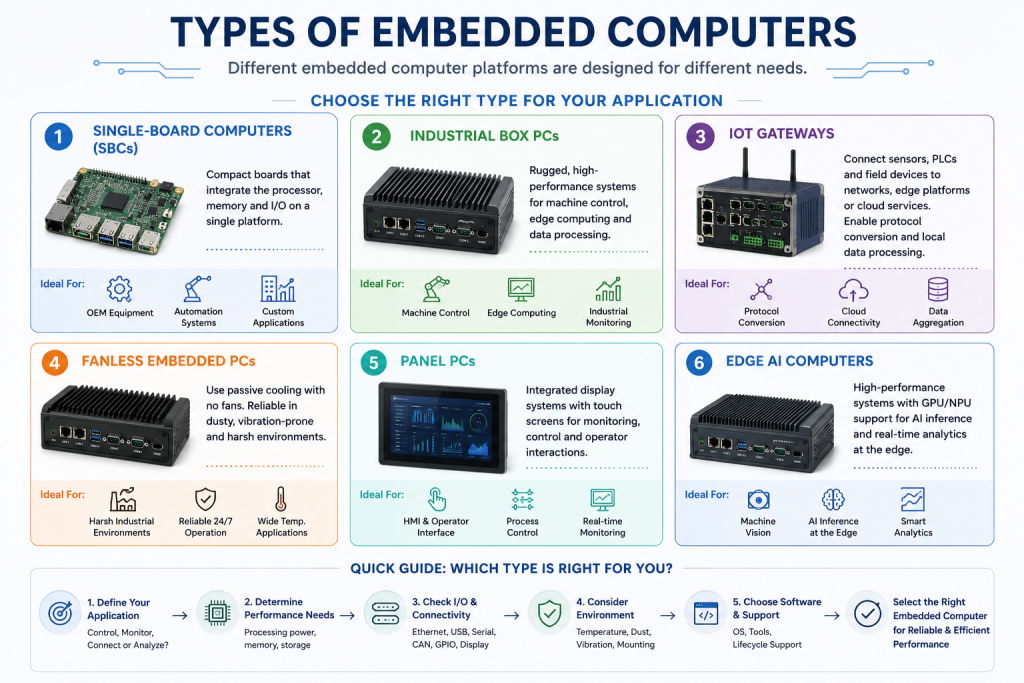
Single-board computers (SBCs): Compact boards that integrate the processor, memory and I/O on a single platform. They are widely used in OEM equipment and automation systems. ITG offers Industrial single-board computers designed for a range of industrial and embedded applications.
Industrial Box PCs: These systems connect sensors, PLCs and other field devices with higher-level networks, edge platforms or cloud services. Modern industrial embedded Box PCs are commonly used for machine control, edge computing, monitoring and other demanding automation workloads.
IoT Gateways: Industrial IoT gateways connect sensors, PLCs and other field devices with higher-level networks, edge platforms or cloud services. Industrial IoT gateways can also perform protocol conversion, local data processing and communication between otherwise incompatible systems.
Fanless embedded PCs: Systems that use passive cooling instead of mechanical fans, reducing moving parts and helping limit dust intake.
Panel PCs: Computing hardware combined with an integrated display or touchscreen for human-machine interfaces and operator control.
Edge AI computers: Edge AI adds local machine-learning inference. An embedded AI computer can analyze camera feeds, detect manufacturing defects, identify objects or evaluate equipment data in real time.
Embedded System vs General-Purpose Computing System
The main difference between an embedded system and a general-purpose computing system is purpose.
A desktop or laptop is designed to run many unrelated applications. An embedded system is designed around a specific device, machine or process and usually performs a defined set of tasks.
| Feature | Embedded System | General-Purpose Computer |
|---|---|---|
| Purpose | Dedicated | Multiple applications |
| Hardware | Selected for a defined workload | Broad, standardized configuration |
| Software | Firmware or application-specific | General desktop/server software |
| Real-time response | Often important | Usually not deterministic |
| Form factor | Compact or machine-specific | Standard PC formats |
| I/O | Industrial/application-specific | General-purpose |
| Environment | Can be ruggedized | Usually controlled |
| Lifecycle | Often long | More frequent upgrade cycles |
An embedded computer is also not the same as a microcontroller. A microcontroller can be the processing component of an embedded system, but embedded computers can also use high-performance processors, x86 or ARM architectures, GPUs and full operating systems.
Operating Systems and Connectivity
Bare-metal firmware suits tightly defined tasks with minimal resources. An RTOS is useful when predictable timing is critical. Embedded Linux is common in gateways, networking and IoT applications, while industrial PCs may use Windows when existing automation or engineering software requires it.
Connectivity can include Ethernet, serial interfaces, Wi-Fi, cellular networks and industrial Ethernet connectivity. In larger automation environments, reliable industrial Ethernet connectivity is especially important for linking embedded computers with PLCs, cameras, sensors, HMIs and other networked equipment.
Applications of Embedded Computers
Industrial Automation and Robotics
Factories use embedded computers for machine control, robotics, production monitoring, data acquisition and communication between shop-floor equipment and higher-level systems. These platforms form an important part of modern industrial automation solutions, particularly where continuous operation and specialized connectivity are required.
Machine Vision and Quality Inspection
Machine-vision systems combine industrial cameras with embedded computing to inspect products, read codes, measure dimensions or detect defects. Edge AI platforms can add machine-learning-based inspection without sending every image to the cloud.
Transportation
Embedded computers support vehicle telematics, fleet management, passenger information, railway applications and onboard video systems. Rugged hardware is valuable where vibration and changing temperatures are expected.
Healthcare, Energy and Infrastructure
Medical equipment uses embedded computing for monitoring, imaging and equipment control. Energy and utility systems use it for data acquisition and infrastructure monitoring, while smart-building systems use embedded platforms for surveillance and access control.
Retail and Digital Systems
Self-service kiosks, ATMs, digital signage players and point-of-sale systems are common embedded computer examples because they are built around specific functions and often operate for long periods with limited maintenance.
What Makes an Industrial Embedded Computer Different?
Unlike consumer PCs, industrial embedded computers are designed for continuous operation in demanding environments. They may feature fanless cooling, wide operating-temperature support, rugged construction, flexible mounting options, wide-range DC input and industrial communication interfaces for integration with machines, sensors and control systems.
Long lifecycle support also matters because industrial machines may remain deployed for many years, making platform changes costly and disruptive.
Embedded Computers, Edge Computing and AI
Edge computing expands the role of embedded computers by processing data close to where it is generated instead of sending everything to a remote cloud platform. This can reduce latency and bandwidth requirements while allowing systems to continue operating when connectivity is limited.
Edge AI adds local machine-learning inference. An embedded AI computer can analyze camera feeds, detect manufacturing defects, identify objects or evaluate equipment data in real time. GPUs, NPUs and dedicated accelerators are increasingly relevant for these workloads.
This makes embedded computing a key part of industrial IoT, machine vision, predictive maintenance and intelligent automation.
Security in Embedded Computing
Connected embedded systems need security to be considered from the design stage. Depending on the platform, useful capabilities may include TPM support, secure boot, device authentication, encrypted storage, signed firmware and controlled software updates.
Security should not be treated as an automatic benefit. A device with outdated firmware, exposed services or weak credentials can become a long-term cybersecurity risk, especially when it stays deployed for many years.
Benefits and Limitations of Embedded Computers
Embedded computers can be compact, energy-efficient and optimized for a specific workload. Industrial platforms can provide reliable continuous operation, specialized I/O and rugged designs. Local processing can also reduce latency and dependence on cloud connectivity.
However, embedded systems involve trade-offs. Engineers may need to work within limits on power, heat, memory, storage or physical space. Hardware and software compatibility must be planned carefully, and long deployments create additional requirements for cybersecurity updates and component lifecycle management.
The best embedded computer is therefore not necessarily the most powerful one. It is the platform that meets the application’s performance, environmental, connectivity and lifecycle requirements.
How to Choose an Embedded Computer
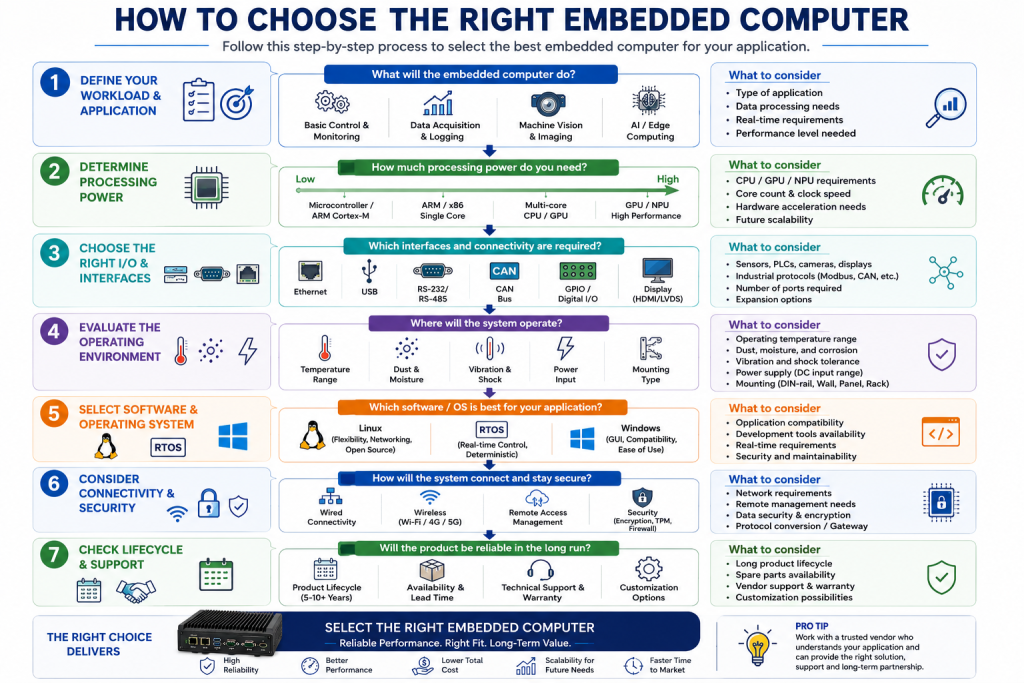
1. Define the workload. Determine whether the system performs basic control, data acquisition, visualization, machine vision, AI inference or another task.
2. Size processing, memory and storage. Choose enough CPU, GPU/NPU capability, RAM and storage for the actual workload.
3. List required interfaces. Check LAN, USB, serial ports, CAN, GPIO, digital I/O, display outputs and expansion requirements.
4. Evaluate the environment. Confirm operating temperature, vibration, dust, mounting and power-input conditions.
5. Verify software support. Check operating-system compatibility, drivers, application requirements and any real-time needs.
6. Plan connectivity and security. Determine how the system will communicate and which protections are required for its network and data.
7. Consider lifecycle and support. For industrial deployments, long-term availability and technical support can be as important as processor speed.
Conclusion
An embedded computer is a purpose-built computing platform designed around the functional, environmental and operational requirements of a larger system.
From single-board computers and IoT gateways to fanless Box PCs and AI-enabled edge systems, embedded computing now supports everything from basic control to real-time machine vision and intelligent automation.
Choosing the right platform requires balancing processing performance with I/O, software compatibility, environmental durability, security and long-term availability. For industrial projects, that system-level approach is what turns an embedded computer from a component into a reliable part of the overall solution.

