GPU for Industrial AI Applications in India: A Practical Guide for Engineers and System Integrators
Graphics Processing Units (GPUs) have evolved beyond traditional graphics workloads to become critical infrastructure for industrial computing. They enable real-time AI inference, high-throughput machine vision, predictive maintenance modeling, and automation at scale. With their parallel processing architecture, GPUs accelerate data-intensive workloads-allowing industries to optimize performance, minimize operational risks, and deploy intelligent systems across production environments.
For manufacturers, automation engineers, and system integrators, understanding GPU technology is key to unlocking edge AI capabilities tailored for real-world industrial conditions-such as dusty shop floors, high-vibration machinery, wide ambient temperature ranges, and the need for reliable local support. At ITG India, we specialize in rugged industrial computing solutions, including NVIDIA Jetson edge devices and AAEON BOXER AI systems, designed to bring GPU acceleration into practical, real-world deployments.
This guide explores GPUs for industrial AI applications in depth – from core concepts and hardware types to real-world use cases and a step-by-step selection framework designed for industrial environments.
Table Of Contents
- What is a GPU and Why Does Industrial AI Need It?
- GPU vs CPU: What Every Industrial Engineer Needs to Know
- Inside the GPU: Core Types That Matter for Industrial Applications
- Industrial Applications of GPU Technology in India
- Types of Industrial GPUs: iGPU, Discrete, and Jetson Embedded
- Thermal and Environmental Considerations for Indian Industrial Deployments
- PCIe Integration: Connecting GPUs in Industrial PCs
- How to Choose the Right GPU Platform: A Decision Framework for Indian Engineers
- When a GPU Isn’t Necessary: Right-Sizing Your Edge AI Hardware
- ITG India’s Industrial GPU Portfolio
What is a GPU and Why Does Industrial AI Need It?
A GPU (Graphics Processing Unit) is a specialized processor designed for parallel computing. Unlike a CPU, which handles sequential operations using a handful of powerful cores, a GPU contains thousands of smaller cores working simultaneously – making it exceptionally efficient at the kind of matrix math that underpins deep learning inference, image processing, and sensor fusion.
In industrial AI applications, this parallel processing power is not optional – it is essential. Consider a machine vision system inspecting components on an automotive assembly line. The system must process high-resolution camera feeds, run a defect detection model, and output a pass/fail decision – all within milliseconds, continuously, at production speed. A CPU simply cannot keep up. A GPU accelerates that inference pipeline by orders of magnitude.
India’s Industry 4.0 momentum reinforces this need. The IndiaAI Mission – backed by over ₹8,500 crore – is deploying tens of thousands of NVIDIA GPUs to build sovereign AI compute infrastructure. Meanwhile, partnerships like L&T and NVIDIA are developing gigawatt-scale AI factories in India. The ecosystem is maturing rapidly, and industrial GPU deployments are no longer limited to large enterprises – mid-sized manufacturers and system integrators across India are deploying edge GPU systems today.
GPU vs CPU: What Every Industrial Engineer Needs to Know
Both CPUs and GPUs handle computation, but their architectures serve very different purposes. Understanding this distinction helps engineers make the right hardware decision for each application.
<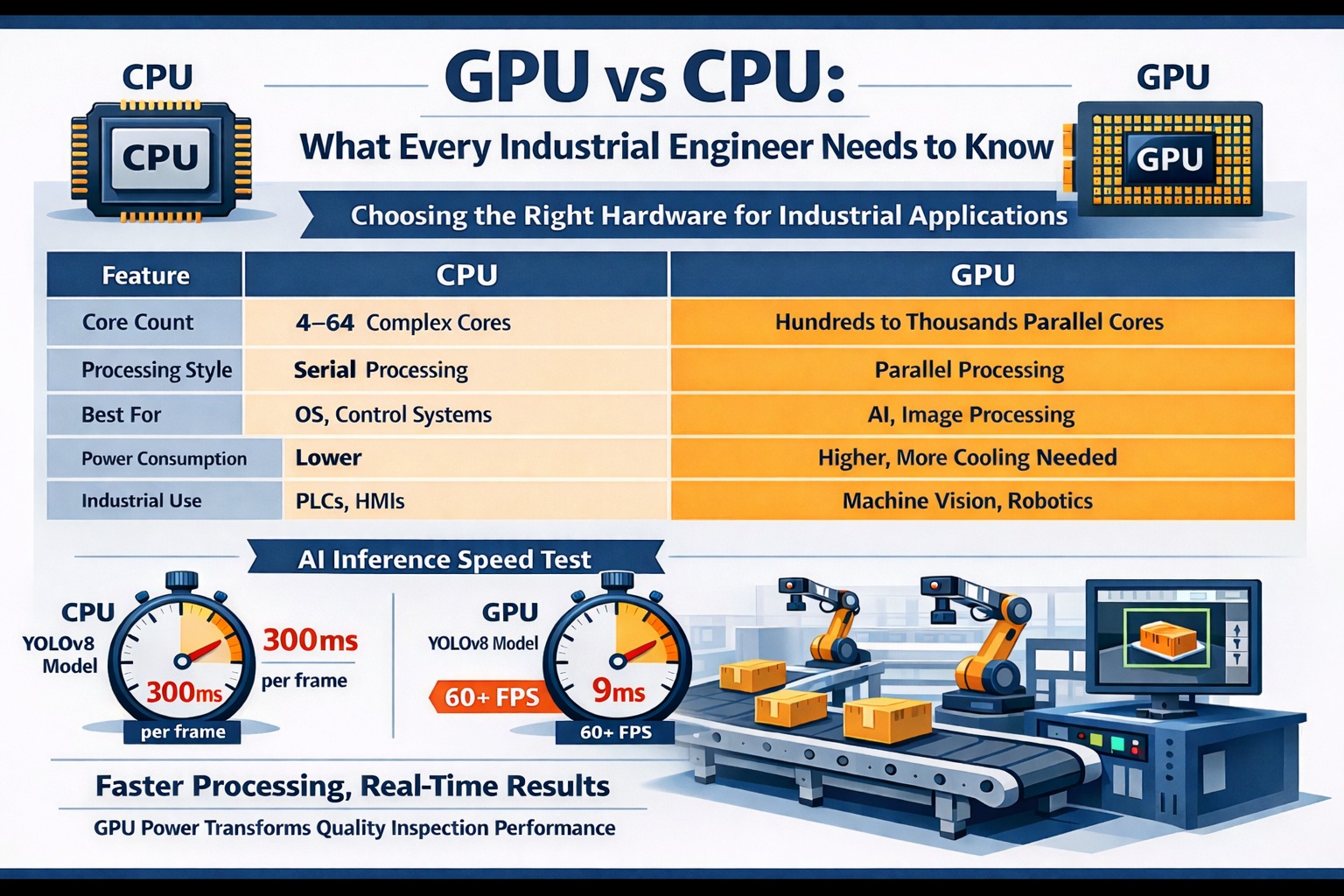
| Feature | CPU | GPU |
|---|---|---|
| Core Count | 4–64 (complex, powerful cores) | Hundreds to thousands (simpler, parallel cores) |
| Processing Style | Serial – one task after another | Parallel – thousands of calculations simultaneously |
| Best For | OS management, logic, control systems | AI inference, image processing, sensor fusion |
| Power Consumption | Lower | Higher – requires thermal management |
| Industrial Strength | PLCs, gateways, HMIs | Machine vision, deep learning, robotics |
For industrial AI workloads, a GPU’s parallel architecture transforms processing time. Running a YOLOv8 object detection model on a CPU might take 200–400ms per frame – too slow for real-time inspection. The same inference on a GPU like the NVIDIA Jetson AGX Orin takes under 10ms, enabling 60+ FPS processing with headroom to spare.
This difference is not academic. It determines whether your quality inspection system can keep pace with your production line.
Inside the GPU: Core Types That Matter for Industrial Applications
Modern industrial GPUs – particularly the NVIDIA Jetson series that ITG India supplies – feature three specialized core types, each optimized for a different class of workload.
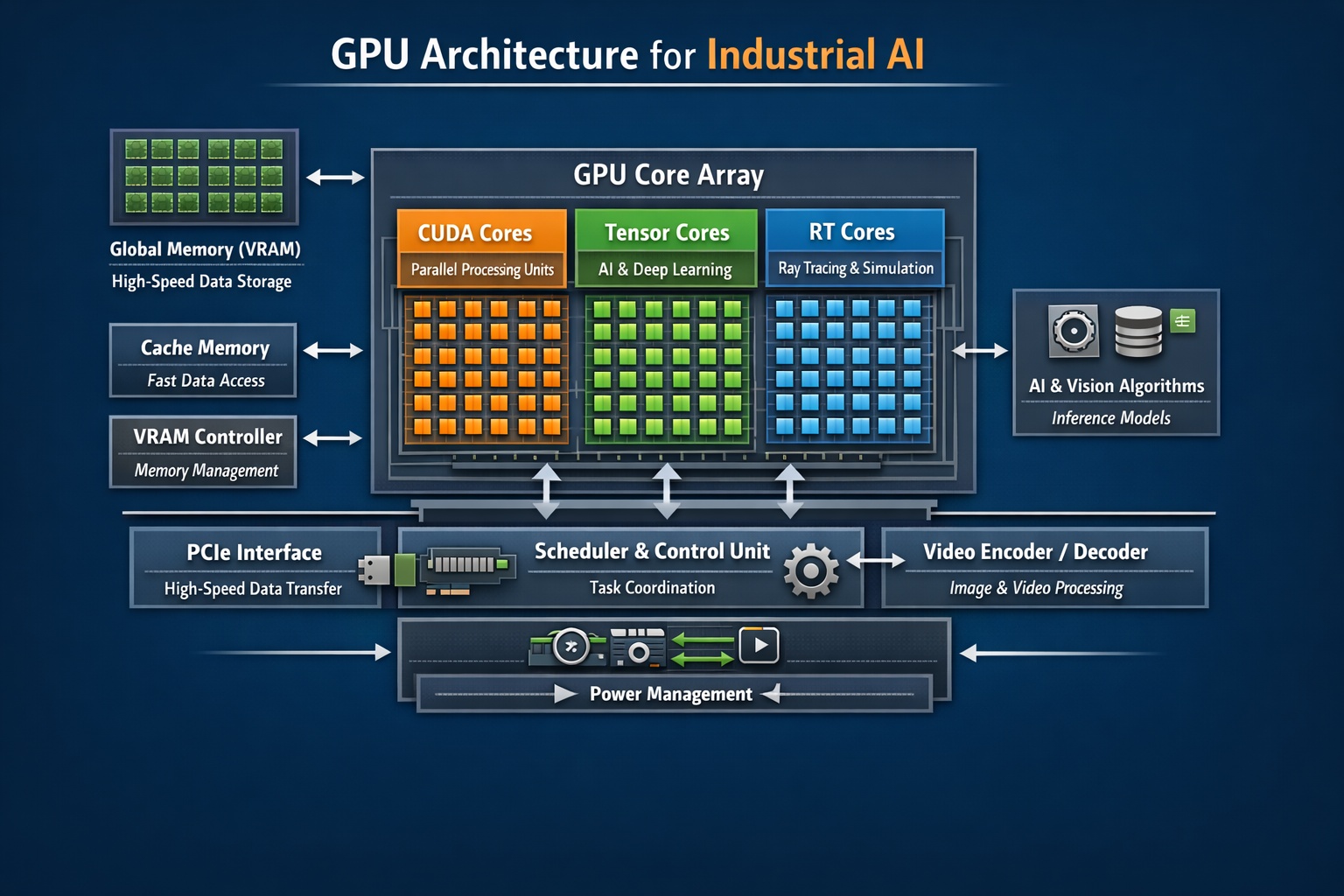
CUDA Cores are the primary parallel processing units responsible for general mathematical calculations, rendering pipelines, and simulations. Within a GPU generation, higher CUDA core counts indicate higher raw throughput.
Tensor Cores are specifically architected for deep learning matrix operations – the mathematical backbone of neural network inference. They dramatically accelerate AI models compared to CUDA cores alone, making them indispensable for real-time inference at the edge.
RT Cores (Ray Tracing Cores) enable photorealistic rendering with physically accurate lighting, reflections, and shadows. In industrial contexts, they power digital twin simulations and mixed-reality training environments – applications increasingly adopted in Indian manufacturing for process planning and operator training.
For most industrial AI deployments in India, Tensor Core count is the most critical specification. If you’re running models like YOLOv8, ResNet, or custom defect detection networks, Tensor Core performance directly determines your inference latency and throughput.
Industrial Applications of GPU Technology in India
GPUs are transforming Indian industry across several high-impact use cases. Here are the most active and commercially proven applications.
Machine Vision and Automated Quality Inspection
This is the most widely deployed industrial GPU application in India today. GPU-accelerated vision systems process high-resolution camera feeds to detect surface defects, dimensional deviations, and assembly errors at 60+ FPS – speeds impossible with CPU-based vision.
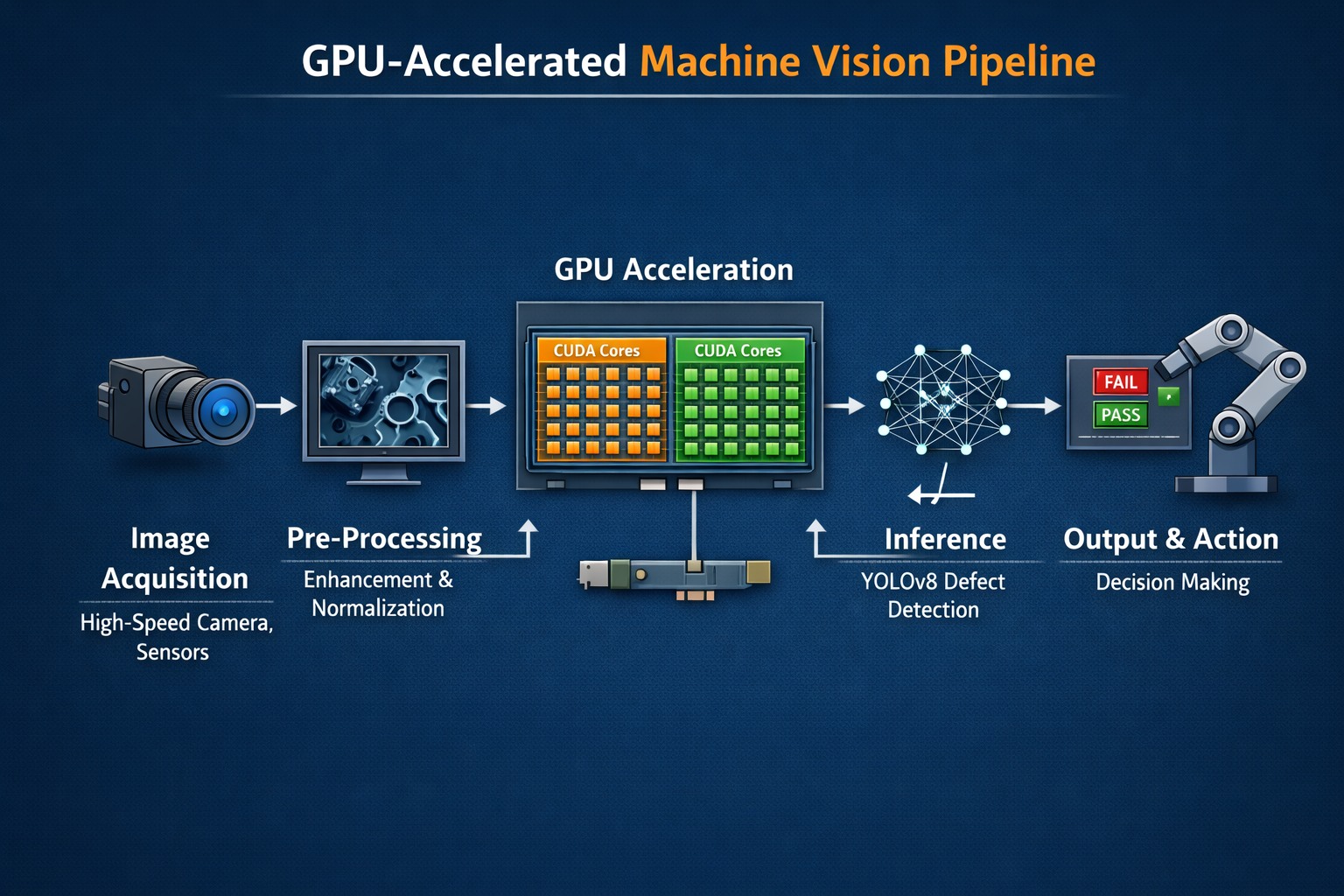
Indian automotive component manufacturers, electronics assembly plants, and pharmaceutical packaging lines are adopting GPU vision systems to achieve zero-defect production targets. A well-configured system can inspect thousands of units per minute, with AI models trained to recognize defect classes specific to each product. The result: scrap reduction of 20–30% and elimination of manual visual inspection bottlenecks.
ITG India’s AAEON BOXER-8640AI, powered by NVIDIA Jetson AGX Orin, is purpose-built for this use case – offering four PoE camera ports, 5GbE connectivity, and a fanless design rated for wide-temperature industrial environments.
Predictive Maintenance in 24/7 Manufacturing
Unplanned downtime is one of the costliest problems in Indian continuous-process industries – from steel and cement to chemical and power. GPU-enabled predictive maintenance systems analyze vibration, acoustic, thermal, and current data from machinery in real time, running anomaly detection models that flag early-stage failure signatures before catastrophic breakdown occurs.
Deployed at the edge – close to the machine, without dependency on cloud connectivity – these systems can reduce unplanned downtime by up to 50% while building a local data record that continuously improves model accuracy over time.
Robotics, AGVs, and Warehouse Automation
Autonomous Mobile Robots (AMRs) and Automated Guided Vehicles (AGVs) rely on GPUs for SLAM (Simultaneous Localization and Mapping), real-time obstacle avoidance, and path planning. India’s rapidly growing e-commerce and logistics sector – with fulfillment centers in Mumbai, Delhi NCR, Bangalore, and Hyderabad – is a major adopter of GPU-powered mobile robotics.
NVIDIA Jetson platforms are the dominant hardware choice for robotics in India, offering the compute density needed for onboard AI while consuming far less power than server-class GPUs.
Smart City Surveillance and Traffic Analytics
GPU edge devices are central to India’s smart city mission, powering ANPR (Automatic Number Plate Recognition), crowd density monitoring, traffic flow analysis, and anomaly detection across city camera networks. Processing video locally at the edge – rather than streaming raw feeds to a central data center – reduces bandwidth costs, improves latency, and ensures operations remain functional even during network disruptions.
ITG India provides NVIDIA Jetson-based edge AI systems deployed in smart city projects across Rajasthan and other Indian states, offering the local support and RMA capabilities that government and municipal clients require.
Types of Industrial GPUs: iGPU, Discrete, and Jetson Embedded
Integrated GPUs (iGPUs)
An integrated GPU shares memory and power with the CPU on the same die. iGPUs are power-efficient, generate less heat, and are well-suited for fanless industrial designs. They are appropriate for lightweight inference tasks – simple image classification, basic object detection with small models, or HMI graphics acceleration.
For industrial PCs running single-camera vision or basic AI inference, an iGPU built into an Intel Core or AMD Ryzen embedded processor may be sufficient – and eliminates the cost and thermal complexity of a discrete GPU.
Discrete GPUs
A discrete GPU has its own dedicated VRAM, separate from system RAM, and delivers significantly higher AI performance than iGPUs. Discrete GPUs are necessary for multi-model inference, high-frame-rate multi-camera systems, or training workloads at the edge.
The tradeoff: higher power consumption (30–275W depending on class), significant heat generation, and the need for active cooling – which conflicts with fully fanless industrial designs. ITG India offers hybrid fanless systems from Advantech products that isolate the GPU in an actively cooled bay while keeping the motherboard and sensitive electronics in a sealed, ventless enclosure.
NVIDIA Jetson Embedded GPU Modules
For the majority of industrial edge AI deployments in India, NVIDIA Jetson represents the optimal balance of AI performance, power efficiency, and ruggedization. Jetson modules integrate CPU, GPU, and often an NPU on a single compact board, purpose-designed for embedded deployment.
| Model | Platform | GPU Specs | VRAM | Best For |
|---|---|---|---|---|
| BOXER-8222 AI | Jetson Nano | 128-core Maxwell | 4GB LPDDR4 | Entry-level vision, basic inference |
| BOXER-8251 AI | Jetson Xavier NX | 384-core Volta + Tensor | 8GB LPDDR4x | Multi-camera inspection |
| BOXER-8640 AI | Jetson AGX Orin | 1792-core Ampere + Tensor | 32GB LPDDR5 | Robotics, complex multi-model AI |
All AAEON BOXER series systems supplied by ITG India operate across -25°C to 60°C, withstand industrial vibration and shock, and carry IP-rated enclosures suitable for Indian factory conditions including dust, humidity, and temperature extremes.
Thermal and Environmental Considerations for Indian Industrial Deployments
This is a dimension that many international GPU guides overlook – but it is critical for Indian installations.
Indian factory floors regularly experience ambient temperatures of 40–50°C in summer, particularly in Rajasthan, Gujarat, Maharashtra, and Tamil Nadu. Monsoon humidity adds moisture ingress risk. High-vibration environments near heavy press machinery or conveyor systems create mechanical stress on standard electronics.
When specifying a GPU platform for Indian industrial use, verify:
- Operating temperature range – minimum -25°C to 60°C for most applications; -40°C to 85°C for outdoor or transportation deployments
- Ingress protection rating – IP54 minimum for dusty environments; IP65 or higher for washdown areas
- Conformal coating – circuit board protection against humidity condensation
- Vibration and shock ratings – per MIL-STD-810 or EN 50155 for transport applications
- MTBF rating – industrial-grade components with 100,000+ hour MTBF ensure continuity on critical lines
ITG India’s Level 2 RMA certification from Advantech means that when hardware issues occur, repair turnaround happens locally in India – not through lengthy international RMA cycles that can leave production lines idle for weeks.
PCIe Integration: Connecting GPUs in Industrial PCs
For industrial PCs that accept discrete GPU expansion cards, the connection interface is PCIe (Peripheral Component Interconnect Express). Understanding PCIe basics helps engineers correctly specify expansion chassis and validate GPU compatibility.
GPUs connect via PCIe slots (x4, x8, or x16 mechanical size). The number of PCIe lanes and generation determine bandwidth:
| PCIe Gen | x8 Lanes Throughput | x16 Lanes Throughput |
|---|---|---|
| PCIe 3.0 | 64 GT/s | 128 GT/s |
| PCIe 4.0 | 128 GT/s | 256 GT/s |
| PCIe 5.0 | 256 GT/s | 512 GT/s |
For most edge AI inference workloads, PCIe 4.0 x8 provides more than sufficient bandwidth. Advantech industrial servers with PCIe Gen 4 slots – available through ITG India – offer the flexibility to run a GPU in one slot while maintaining an open slot for additional I/O expansion.
How to Choose the Right GPU Platform: A Decision Framework for Indian Engineers
Use this structured approach to select the right GPU solution for your application.
Step 1 – Define your workload. How many camera streams? What model architecture (YOLOv8, ResNet, custom)? What is your required inference latency? A single-camera, 30 FPS defect detection task has very different GPU requirements than a 12-camera, multi-model robotics navigation system.
Step 2 – Assess your environment. What is the ambient temperature range at the installation site? Is there dust, vibration, or moisture? Does the system need to be fanless? Indian factory conditions are often more demanding than the specifications most generic industrial PCs are built for.
Step 3 – Determine inference vs. training. If your AI models are pre-trained and you only need to run inference at the edge, a Jetson platform is almost always the right answer – it offers excellent inference performance per watt. If you need to perform on-site training or fine-tuning on new defect classes, a higher-end discrete GPU platform is necessary.
Step 4 – Evaluate total cost of ownership. Factor in not just purchase price but power consumption, cooling infrastructure, local support availability, and spare parts access. ITG India’s local stocking, demo availability, and Advantech-certified RMA support reduce TCO significantly for Indian deployments versus importing hardware without local service coverage.
Step 5 – Plan for scalability. Start with a BOXER-8222AI or BOXER-8251AI for pilot projects. As your AI application matures and workloads grow, scale to AGX Orin without changing your software stack – NVIDIA’s unified CUDA/JetPack ecosystem ensures compatibility across the Jetson product line.
When a GPU Isn’t Necessary: Right-Sizing Your Edge AI Hardware
Not every industrial AI deployment needs a GPU. Over-specifying hardware is a common and costly mistake.
For simple binary classification (pass/fail on a single product feature), a modern CPU with an integrated NPU – such as Intel’s OpenVINO-compatible processors available on Advantech embedded boards – is often sufficient and significantly less expensive. NPUs are purpose-built for running pre-compiled inference models at low power, without the thermal overhead of a discrete GPU.
A useful rule of thumb: if your application involves fewer than 3 simultaneous camera streams and uses a lightweight model under 50MB, an NPU or iGPU solution will likely meet your needs. Once you exceed 4 streams, use complex segmentation models, or require real-time SLAM, GPU acceleration becomes necessary.
ITG India’s Industrial GPU Portfolio
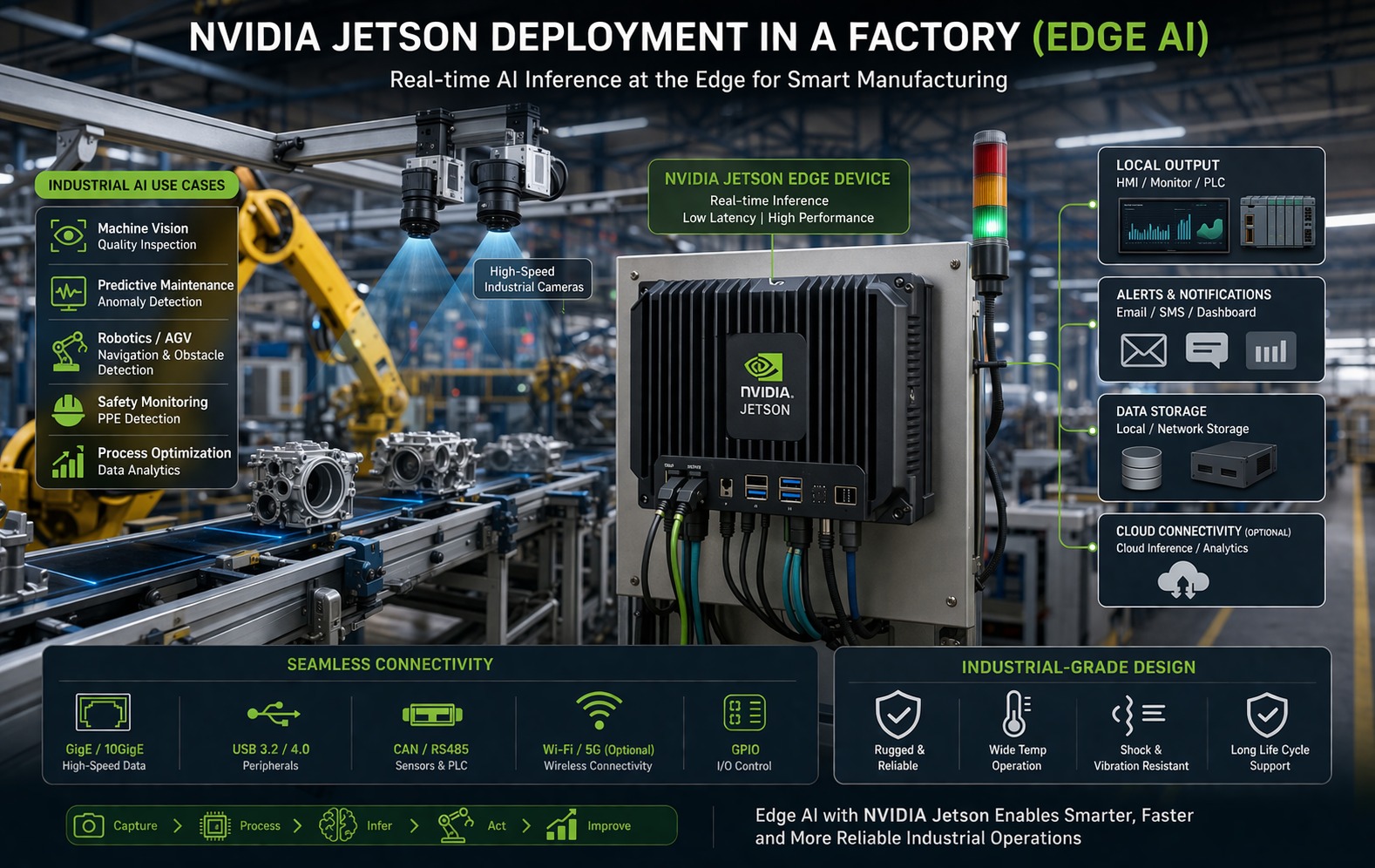
ITG India is an authorized partner for Advantech, AAEON, and NVIDIA edge AI products in India, with over two decades of experience deploying industrial computing solutions across manufacturing, energy, transportation, and government sectors.
<
Our GPU-enabled product portfolio includes:
- AAEON BOXER AI Series – Compact, fanless embedded AI systems with NVIDIA Jetson Nano, TX2 NX, Xavier NX, and AGX Orin. Available now for evaluation and pilot deployment. [Explore NVIDIA Edge Devices]
- Advantech AIR/MIC Series – Industrial AI inference platforms with discrete GPU support for demanding multi-camera and robotics applications.
- Embedded SBCs with GPU Expansion – Single Board Computers supporting PCIe GPU modules for custom-build industrial systems. [Browse Industrial SBCs]
We offer end-to-end support including pre-sales technical consultation, on-site hardware demonstrations, system integration assistance, and Advantech-certified Level 2 RMA services- ensuring reliable support across India.
Ready to evaluate a GPU platform for your application? Contact our technical team at sales@itgindia.com or call +91-9001158222 for a consultation or demo request.