
Media Converter: The Complete Guide to Industrial Ethernet and Fiber Connectivity
Table of Contents
- Quick Summary
- What is a Media Converter?
- Why Media Converters Are Essential for Industrial Ethernet Networks
- Types of Media Converters
- How to Choose the Right Industrial Connectivity Solution
- Industrial Applications of Media Converters
- Common Challenges Solved by Media Converters
- Conclusion
Industrial automation depends on reliable communication between PLCs, HMIs, SCADA servers, Industrial Ethernet switches, and remote I/O systems. As industries adopt Industry 4.0 and Industrial IoT (IIoT), traditional copper Ethernet networks often struggle to support longer transmission distances and increasing data demands.
Instead of replacing an entire network with fiber infrastructure, businesses can use a media converter to seamlessly connect copper Ethernet and fiber optic networks. This enables cost-effective network expansion while improving communication reliability in demanding industrial environments.
In this guide, we’ll explain how media converters work, explore their different types, discuss industrial applications, and help you choose the right solution for your Industrial Ethernet network.
Quick Summary
- Learn how media converters connect copper Ethernet and fiber optic networks.
- Compare Ethernet to Fiber, Serial to Fiber, and PoE Media Converters.
- Understand single-mode vs. multimode fiber.
- Discover industrial applications and best practices for selecting the right solution
What is a Media Converter?
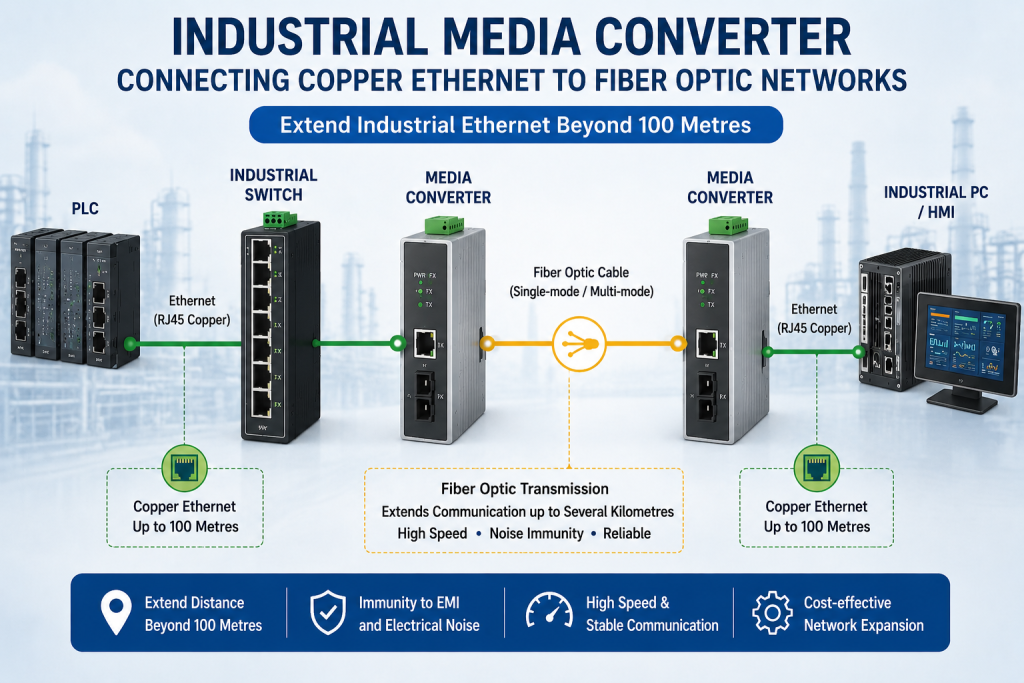
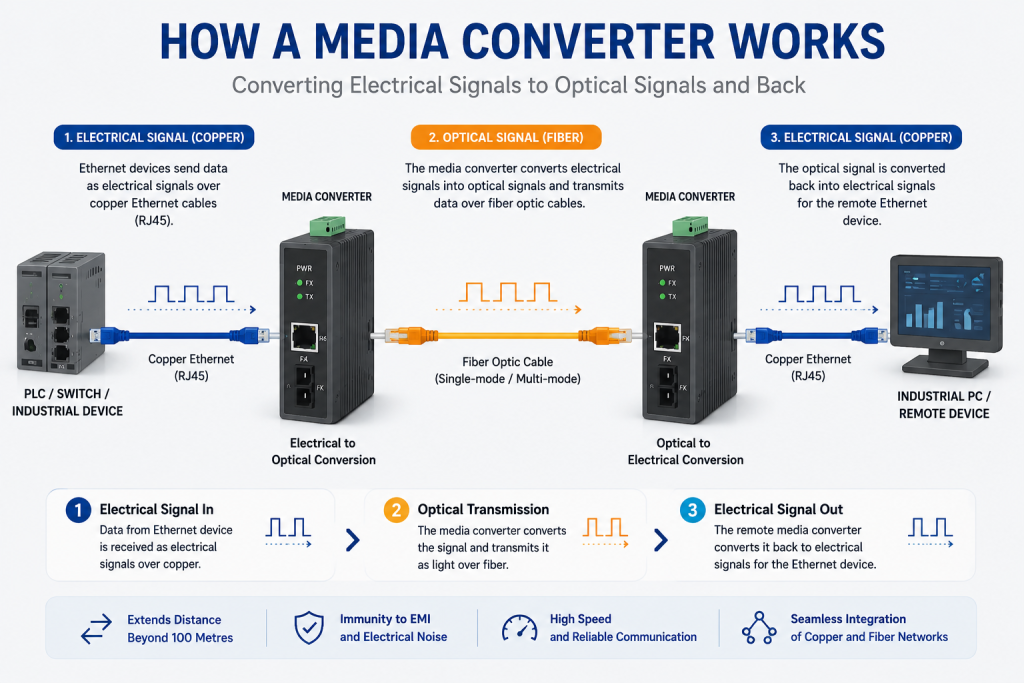
A media converter is a networking device that connects copper Ethernet and fiber optic networks by converting electrical Ethernet signals into optical signals-and vice versa-without changing the communication protocol. It allows businesses to extend network distances, improve communication reliability, and integrate existing Ethernet infrastructure with modern fiber networks without replacing critical equipment.
In industrial environments, these devices play a crucial role in ensuring stable, high-speed communication between PLCs, Industrial PCs, Ethernet switches, and other automation devices, even across long distances or electrically noisy environments.
A media converter performs this conversion in real time, allowing Ethernet devices to communicate over fiber optic networks without modifying the existing communication protocol. This makes it one of the simplest and most cost-effective ways to modernize industrial communication infrastructure.
Why Media Converters Are Essential for Industrial Ethernet Networks
Industrial communication networks operate under conditions that are far more demanding than conventional office environments. Manufacturing plants, oil and gas facilities, substations, railway systems, and warehouses frequently span large areas and contain equipment that generates high levels of electrical interference. Under these conditions, standard copper Ethernet cabling can become a limitation rather than an advantage.
One of the biggest challenges is transmission distance. Conventional Ethernet cables are generally limited to around 100 metres before signal degradation begins to affect communication quality. Fiber optic cables overcome this limitation by transmitting data over several kilometres while maintaining signal integrity. An Ethernet-to-fiber connectivity solution enables organizations to extend their existing networks without replacing every connected device.
Another important advantage is resistance to electromagnetic interference. Heavy motors, welding machines, variable frequency drives, and high-voltage equipment commonly found in industrial facilities generate electrical noise that can disrupt copper-based communication. Since fiber optic cables transmit data using light instead of electrical signals, they provide excellent EMI protection and maintain reliable communication even in electrically noisy industrial environments.
Beyond improving communication performance, these networking devices also provide significant operational and financial benefits.
Key advantages include:
- Extend Ethernet communication far beyond the limitations of copper cabling.
- Enable seamless integration of copper and fiber infrastructure.
- Improve network reliability in harsh industrial environments.
- Reduce infrastructure upgrade costs by preserving existing equipment.
- Support scalable Industrial Ethernet and Industry 4.0 deployments.
Types of Media Converters
While every conversion device performs the same fundamental function-bridging different transmission media-not every converter is designed for the same application. Industrial networks often consist of a combination of Ethernet devices, legacy serial equipment, fiber optic backbones, and remote monitoring systems, each with unique communication requirements. Selecting the right connectivity solution depends on factors such as network architecture, communication protocol, transmission distance, and the operating environment.
Understanding the different network conversion technologies helps businesses choose the most suitable option while supporting future network expansion.
Ethernet to Fiber Media Converter
Among all available options, the Ethernet to Fiber Media Converter is the most commonly used in Industrial Ethernet networks. It is available in Fast Ethernet (10/100 Mbps) and Gigabit Ethernet (10/100/1000 Mbps) variants, enabling organizations to select the appropriate performance level based on their network bandwidth requirements.
For many industries, this offers a practical way to modernize network infrastructure. Instead of replacing Ethernet switches, PLCs, industrial switches, Industrial PCs, or HMIs, organizations can introduce fiber connectivity exactly where it is needed. This reduces upgrade costs while significantly extending communication distances and improving overall network reliability.
Many industrial models also support SFP ports (Small Form-factor Pluggable), allowing users to choose different fiber transceivers based on transmission distance, fiber type, and application requirements.
The benefits become even more apparent in large facilities where production lines, control rooms, and remote equipment are spread across multiple buildings. Copper cabling quickly reaches its transmission limit, whereas fiber optic communication can maintain stable connectivity over several kilometres with minimal signal loss.
Ethernet to Fiber Media Converters are widely deployed in:
- Manufacturing plants with distributed production lines
- Industrial automation and process control systems
- Smart warehouses and logistics facilities
- Power generation and utility networks
- Railway and transportation infrastructure
- Industrial surveillance and security systems
Serial to Fiber Media Converter
Although Ethernet dominates modern industrial communication, thousands of automation systems still rely on RS-232, RS-422, and RS-485 serial communication. Replacing these systems is often unnecessary, especially when they continue to perform reliably in critical operations.
A Serial to Fiber Media Converter allows these legacy devices to communicate over fiber optic cables by converting serial electrical signals into optical signals and back again at the receiving end. This simple conversion extends communication distances while protecting data from electrical interference commonly found in industrial environments.
By extending serial communication over fiber optic cables, these converters help organizations preserve legacy automation equipment while improving communication reliability across large industrial facilities. They are widely used in SCADA systems, utilities, railway signaling systems, RTUs, surveillance cameras, traffic management infrastructure, substations, and process industries where long-distance serial communication remains essential.
PoE Media Converter
As industrial facilities adopt IP-based surveillance, wireless connectivity, and smart monitoring systems, there is an increasing need to deliver both power and data to remote devices efficiently. Running separate power and network cables increases installation time, material costs, and maintenance complexity.
A PoE (Power over Ethernet) Media Converter solves this challenge by integrating fiber optic communication with Power over Ethernet technology. After receiving data over the fiber network, the converter supplies both electrical power and Ethernet connectivity through a single cable to the connected device.
This makes deployment faster and more economical, particularly in locations where conventional power outlets are unavailable.
Common applications include:
- IP surveillance systems
- Wireless access points
- Access control systems
- Remote monitoring equipment
- Industrial IoT devices
Single-Mode vs. Multimode Media Converters
Selecting the appropriate fiber type is just as important as choosing the right fiber connectivity solution. The decision between single-mode and multimode media converters depends primarily on transmission distance, application requirements, and future scalability.
A single-mode fiber converter uses a narrow fiber core that allows light to travel in a single path. This minimizes signal loss and enables communication over much longer distances, making it ideal for connecting geographically dispersed facilities such as substations, railway networks, utility infrastructure, and industrial campuses.
A multimode fiber converter, by comparison, uses a larger fiber core that supports multiple light paths simultaneously. While the transmission range is shorter, multimode solutions are more economical and perfectly suited for communication within factories, warehouses, commercial buildings, and production facilities.
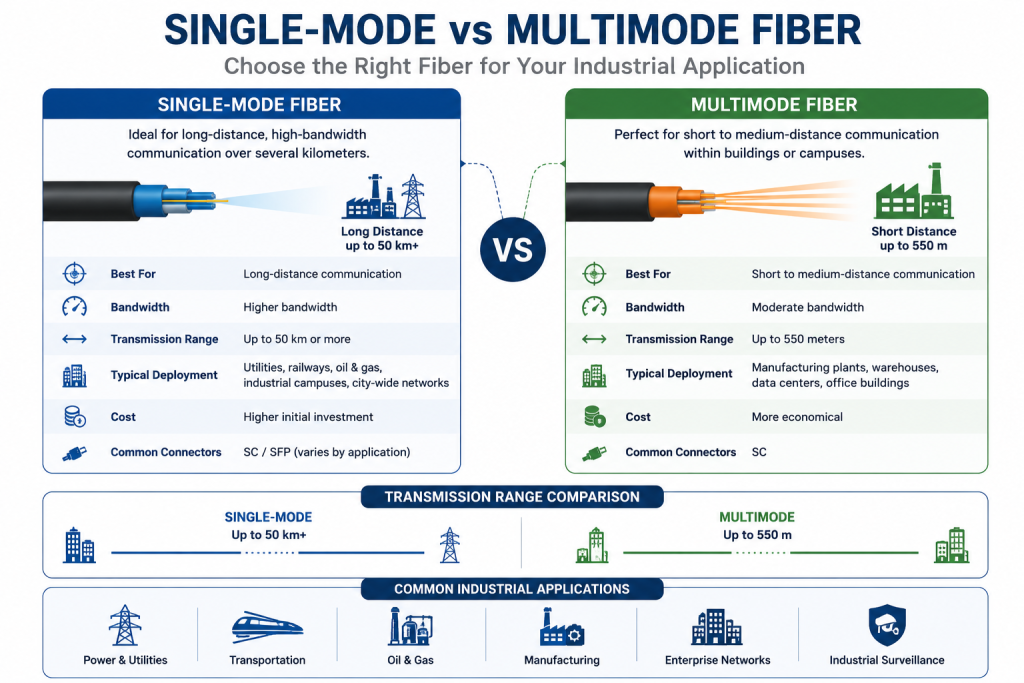
The right choice depends on your transmission distance, application requirements, and future scalability. Selecting the appropriate fiber type during deployment helps improve long-term network performance while reducing future upgrade costs.
Industrial vs. Commercial Media Converters
A common mistake when purchasing networking equipment is assuming that all industrial network converters offer the same level of performance. In reality, devices designed for office environments differ significantly from those engineered for industrial automation.
Commercial media converters are suitable for temperature-controlled indoor environments with minimal electrical interference. Industrial-grade media converters, however, are built specifically to withstand demanding operating conditions such as extreme temperatures, vibration, dust, humidity, and electromagnetic interference.
Industrial models typically include rugged metal enclosures, wide operating temperature ranges, surge protection, redundant power inputs, and DIN-rail mounting options. These features ensure uninterrupted communication in mission-critical environments where network failures can lead to production downtime and operational losses.
For manufacturers, utilities, transportation providers, and process industries, investing in industrial-grade media converters is not simply about durability-it is about ensuring long-term network stability, protecting automation assets, and supporting the continuous operation of critical industrial processes.
How to Choose the Right Industrial Connectivity Solution
Choosing the right networking solution involves more than simply connecting copper and fiber cables. Every industrial network has unique communication requirements, and selecting the appropriate converter ensures reliable performance, easier maintenance, and long-term scalability.
The first step is identifying the communication protocol used by your equipment. If your automation system relies on Ethernet-enabled devices such as PLCs, industrial switches, or Industrial PCs, an Ethernet to Fiber Media Converter is the ideal choice. However, facilities operating legacy equipment using RS-232, RS-422, or RS-485 communication should consider a Serial to Fiber Media Converter to integrate older systems with modern fiber infrastructure.
Transmission distance is another important consideration. For communication within a factory, warehouse, or office campus, multimode fiber generally provides sufficient performance while keeping installation costs low. When connecting remote buildings, substations, or geographically dispersed facilities, single-mode fiber delivers greater transmission distances with minimal signal attenuation.
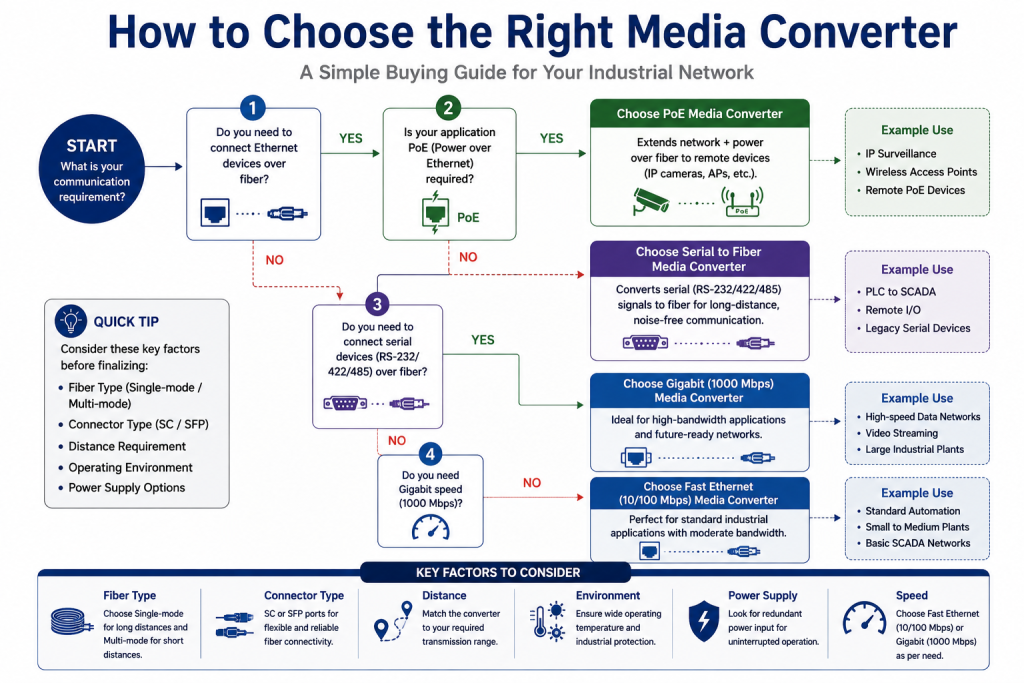
Before selecting an industrial media converter, evaluate these key factors:
| Consideration | Recommendation |
|---|---|
| Communication Protocol | Ethernet or Serial |
| Fiber Type | Single-mode or Multimode |
| Speed | Match network bandwidth |
| Environment | Industrial-grade for harsh conditions |
| Power | Choose PoE where required |
Industrial Applications of Media Converters
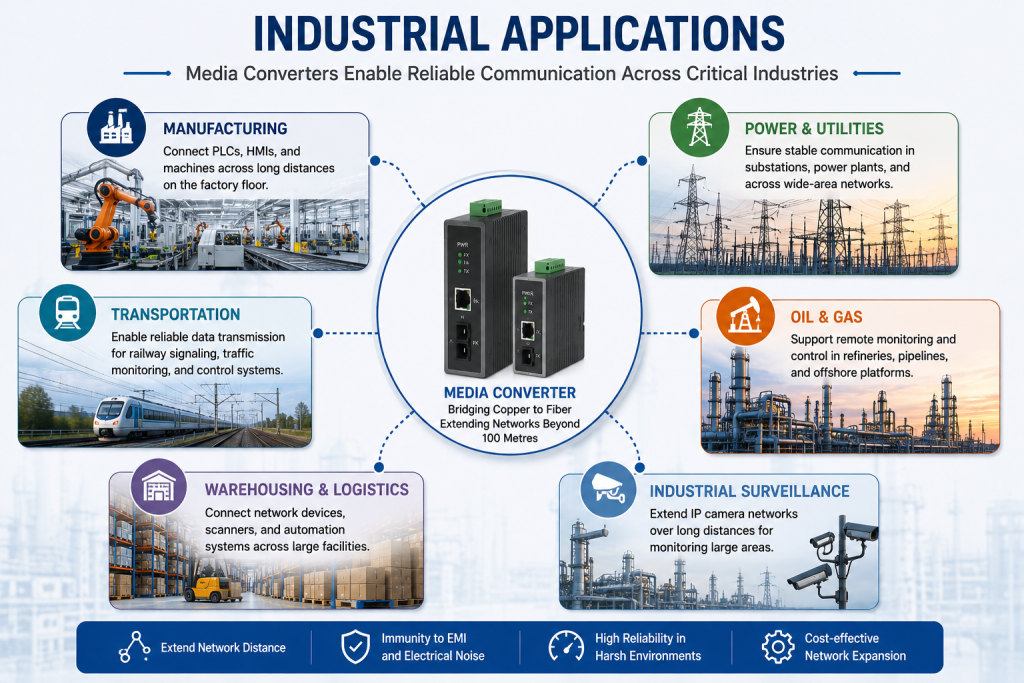
These networking devices are used across a wide range of industries where reliable, long-distance communication is essential. Their ability to integrate existing Ethernet or serial networks with fiber optic infrastructure makes them an indispensable component of modern industrial networking.
In manufacturing facilities, these devices connect production lines, PLCs, HMIs, and industrial control systems spread across large plants. Power utilities and substations use fiber communication to ensure uninterrupted data exchange between remote assets, while transportation networks rely on fiber connectivity solutions for signaling, surveillance, and operational monitoring.
They are equally valuable in industries such as oil & gas, water treatment, mining, and building automation, where harsh environmental conditions demand rugged communication equipment capable of maintaining reliable performance.
As Industrial IoT and smart factory initiatives continue to expand, media converters provide the flexibility needed to connect new digital technologies with existing operational infrastructure without requiring a complete network redesign.
Common Challenges Solved by Media Converters
Industrial communication networks frequently encounter challenges that traditional copper Ethernet infrastructure struggles to address efficiently. These devices improve connectivity, extend transmission distances, and enable seamless integration between different network media.
Some of the most common challenges they help solve include:
- Extending Ethernet communication beyond the 100-meter limitation of copper cables.
- Connecting legacy copper-based equipment with modern fiber optic networks.
- Eliminating communication issues caused by electromagnetic interference (EMI).
- Supporting long-distance connectivity between remote facilities and production areas.
- Modernizing industrial networks without replacing existing automation equipment.
- Improving communication reliability for Industry 4.0 and Industrial IoT (IIoT) applications.
Conclusion
As industrial networks continue to evolve, the ability to connect legacy systems with modern fiber infrastructure has become increasingly important. This networking solution provides a cost-effective way to extend communication distances, improve network reliability, and support the transition toward Industry 4.0 without requiring a complete infrastructure overhaul.
Whether you need an Ethernet to Fiber Media Converter for Industrial Ethernet applications or a Serial to Fiber Media Converter to integrate legacy automation equipment, selecting the right solution ensures stable communication, lower maintenance costs, and greater scalability for future expansion.
At ITG India, we offer a comprehensive range of industrial-grade network converters designed to deliver reliable performance in demanding environments. From manufacturing and utilities to transportation and process industries, our solutions help businesses build secure, high-performance industrial communication networks that are ready for the future.
Explore ITG India’s Media Converter solutions to find the right networking solution for your industrial automation requirements.

