PLC vs IPC vs SoftPLC: Choosing the Right Industrial Controller for Your Automation Needs
Industrial automation in India is evolving rapidly. Manufacturers are no longer looking only for rugged control systems-they also need connectivity, scalability, real-time data processing, and Industry 4.0 readiness. As factories adopt AI-driven inspection, predictive maintenance, and edge computing, choosing the right industrial controller has become a strategic business decision.
Today, industrial automation teams commonly evaluate three major control paradigms:
- Traditional PLCs
- Industrial PCs (IPCs)
- SoftPLC systems
Each architecture offers different advantages in performance, flexibility, determinism, scalability, and long-term cost efficiency. The debate around PLC vs IPC is now expanding further with the rise of SoftPLC platforms powered by industrial computing hardware and software frameworks such as CODESYS SoftPLC.
For Indian factories, OEMs, and system integrators, the challenge is identifying which controller best suits production requirements while maintaining cost-effectiveness and supply chain resilience. This is especially important in sectors such as automotive, pharmaceuticals, packaging, logistics, energy, and smart manufacturing.
At ITG India, businesses can access advanced industrial computing solutions from global leaders like Advantech and AAEON. From rugged fanless IPCs to real-time SoftPLC-ready DIN-rail systems, ITG helps Indian industries modernize automation infrastructure with reliable, future-ready hardware.
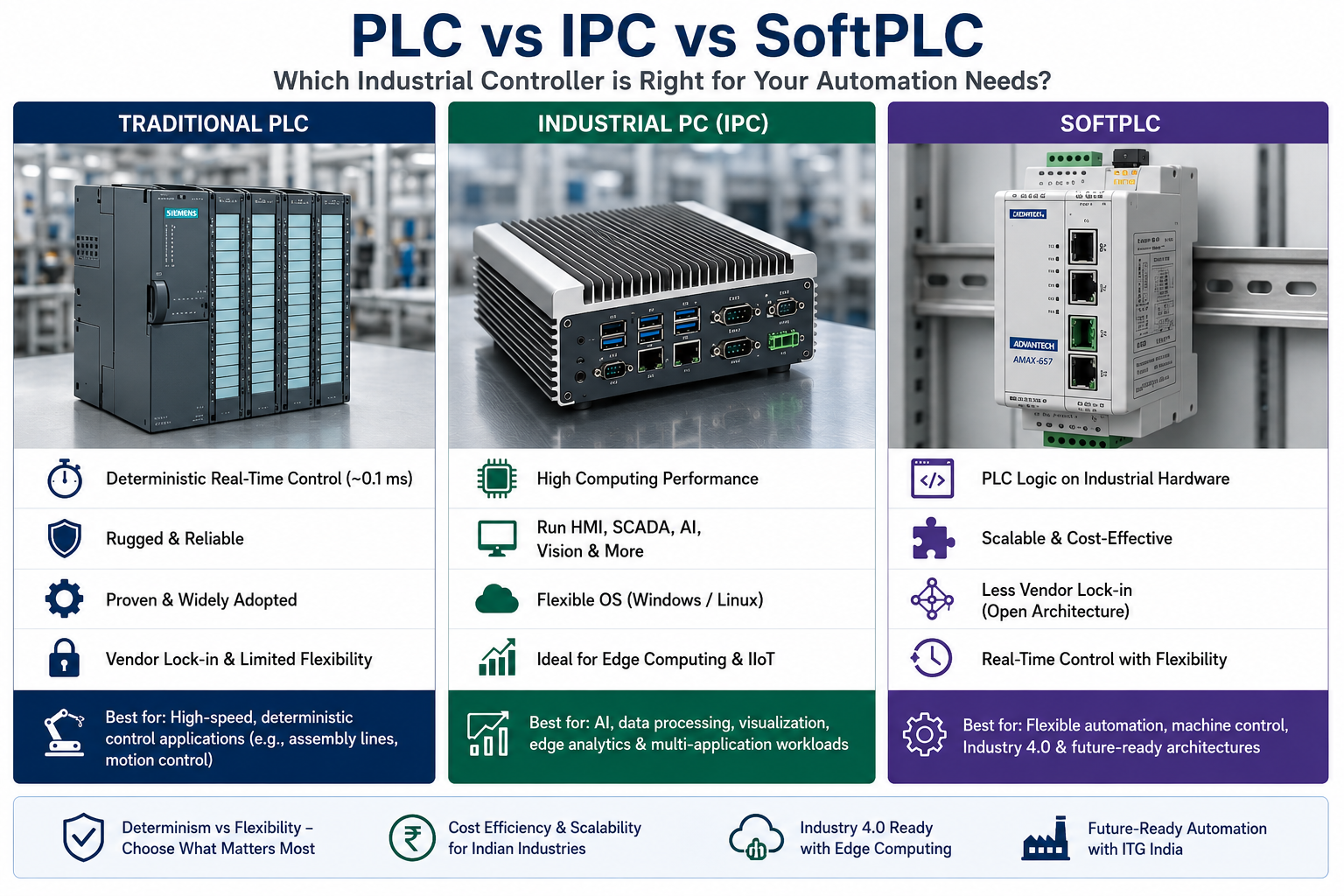
Table of Contents
- What is a Traditional PLC?
- What is an Industrial PC (IPC)?
- What is a SoftPLC?
- Comparing PLC vs IPC vs SoftPLC
- When to Choose Traditional PLCs
- When to Choose Industrial PCs
- When to Choose SoftPLC
- ITG Solutions for Every Need
- Product Capability Matrix
- Decision Flowchart
- Real-World Industry Example: Indian Factory Modernization
- Conclusion
What is a Traditional PLC?
A Programmable Logic Controller (PLC) is a dedicated industrial controller designed specifically for machine automation and real-time control. PLCs have been the backbone of factory automation for decades because they are reliable, deterministic, and rugged.
Traditional PLCs are purpose-built systems optimized for:
- Deterministic control
- High reliability
- Fast scan cycles
- Industrial I/O handling
- Harsh industrial environments
A PLC typically runs ladder logic or IEC 61131-3 programming and communicates with industrial devices such as sensors, motors, relays, actuators, and HMIs.
Advantages of Traditional PLCs
Excellent Real-Time Determinism
PLCs are designed for precise timing operations. Many systems achieve deterministic response times around 0.1ms, making them ideal for motion control, packaging machines, and high-speed assembly lines.
Rugged Industrial Design
PLCs are built to withstand:
Electrical noise
- Heat
- Dust
- Vibration
- Continuous 24/7 operation
Long Lifecycle Support
Industrial plants often operate equipment for 10–20 years. PLC vendors usually provide long-term product support and firmware stability.
Easy Maintenance
Most automation technicians are already familiar with PLC programming environments, simplifying maintenance and troubleshooting.
Limitations of Traditional PLCs
Despite their strengths, traditional PLCs also have limitations.
Limited Computing Power
Modern applications such as AI inspection, machine vision, and edge analytics require higher computational capability than conventional PLCs can provide.
Vendor Lock-In
Many PLC ecosystems rely on proprietary software, communication protocols, and hardware modules. This can increase upgrade costs and reduce flexibility.
Limited Scalability
Integrating advanced technologies such as cloud connectivity, databases, and modern IIoT applications may require additional gateways or middleware.
Common PLC Use Cases
Traditional PLCs remain ideal for:
- Conveyor automation
- Packaging systems
- Automotive assembly lines
- Process control
- High-speed motion control
- Safety-critical automation
However, many Indian manufacturers are now migrating toward IPCs and SoftPLCs to improve flexibility, reduce dependency on proprietary hardware, and support Industry 4.0 initiatives.
What is an Industrial PC (IPC)?
An Industrial PC (IPC) is a ruggedized computing platform designed for industrial environments. Unlike traditional PLCs, IPCs combine industrial durability with the computing power of modern computer processors.
- SCADA systems
- HMI applications
- AI models
- Machine vision software
- Data analytics platforms
- Edge computing workloads
- Industrial communication gateways
Modern IPCs are increasingly becoming the foundation of smart factories and digital manufacturing environments.
Advantages of Industrial PCs
High Computing Performance
Industrial PCs support powerful Intel processors, large RAM capacities, SSD storage, and GPU acceleration. This makes them ideal for compute-intensive applications.
Flexibility
IPCs support:
- Windows
- Linux
- Virtualization
- Docker containers
- AI frameworks
- Cloud integration
This flexibility enables manufacturers to consolidate multiple workloads onto a single platform.
Industry 4.0 Ready
IPC systems are ideal for:
- Edge computing
- Predictive maintenance
- Industrial AI
- Remote monitoring
- Real-time analytics
Reduced Infrastructure Complexity
Instead of deploying separate systems for HMI, data logging, gateway functionality, and analytics, an IPC can handle multiple functions simultaneously.
Limitations of IPCs
Less Deterministic Than PLCs
Standard operating systems such as Windows are not fully deterministic. For ultra-fast motion control or critical timing applications, a pure IPC may not always be ideal.
Higher Configuration Complexity
IPC systems require IT and OT integration expertise, especially when configuring cybersecurity, operating systems, and industrial networking.
ITG IPC Solutions for Indian Industry
ITG India offers advanced IPC platforms suitable for industrial automation, AI, and edge computing deployments.
AAEON BOXER-6404
The AAEON BOXER-6404 is a rugged fanless industrial PC designed for embedded and edge applications.
Key Specifications
- Intel Celeron J1900/N2807
- Up to 8GB DDR3L
- Windows/Linux support
- 4x Gigabit Ethernet
- Fanless operation
- -30°C to 65°C operating range
This system is ideal for:
- Smart factory gateways
- Industrial networking
- Surveillance
- Edge data processing
Advantech UNO-2271G V2
The Advantech UNO-2271G V2 is designed for industrial automation and edge control applications.
Key Specifications
- Intel Celeron N6210/Pentium N6415
- 4GB LPDDR4
- 8DI/8DO
- Wide operating temperature: -30°C to 70°C
Ideal applications include:
- Industrial HMI
- Edge controller deployments
- Smart monitoring systems
- Factory automation gateways
For Indian industries dealing with harsh temperatures and unstable industrial environments, these rugged IPCs provide reliable long-term operation.
What is a SoftPLC?
A SoftPLC is a software-based PLC platform that runs PLC logic on industrial computer hardware instead of proprietary PLC hardware.
SoftPLC systems typically use:
- Industrial PCs
- Embedded edge controllers
- Real-time operating systems
- IEC 61131-3 programming environments
- EtherCAT and industrial Ethernet
Platforms such as CODESYS SoftPLC allow engineers to develop PLC applications using standard programming languages while leveraging the flexibility and power of industrial computing.
SoftPLC systems are becoming increasingly popular in India because they combine:
- PLC-style control
- IPC-level computing power
- Open architecture flexibility
Advantages of SoftPLC
Scalability
SoftPLC systems can scale from small machine control applications to enterprise-wide automation architectures.
Reduced Vendor Lock-In
Since SoftPLCs run on standard hardware platforms, manufacturers gain more flexibility in hardware selection and lifecycle management.
Industry 4.0 Integration
SoftPLCs integrate easily with:
- MES systems
- Cloud platforms
- AI applications
- Databases
- OPC UA environments
Consolidated Architecture
One device can simultaneously perform:
- PLC control
- HMI functionality
- Edge analytics
- Data logging
- Industrial communication
Limitations of SoftPLC
Requires Proper RTOS Configuration
Real-time performance depends on the operating system and hardware optimization.
Higher Engineering Expertise
SoftPLC systems often require stronger IT/OT convergence knowledge compared to traditional PLC deployments.
ITG SoftPLC Solutions
Advantech AMAX-657
The Advantech AMAX-657 is a high-performance SoftPLC platform built for industrial real-time applications.
Key Specifications
- Intel Atom 1.5GHz
- 4GB DDR3
- Embedded Linux RTOS
- 8DI/8DO
- CODESYS IEC-61131-3
- EtherCAT support
- -20°C to 60°C
This platform is ideal for:
- Real-time controller India deployments
- Machine automation
- Motion control
- Smart manufacturing systems
Advantech UNO-148 V2
The Advantech UNO-148 V2 delivers next-generation industrial edge control performance.
Key Specifications
- 13th Gen Intel Core i3/i5/i7
- 8GB–64GB DDR5
- Windows/Linux
- 8DI/8DO
- 2.5GbE TSN
- -20°C to 60°C
This platform supports:
- AI-enabled industrial automation
- Real-time edge computing
- Advanced industrial networking
Advantech UNO-137 V2
The Advantech UNO-137 V2 is a compact and rugged DIN-rail IPC optimized for edge automation.
Key Specifications
- Intel Atom x6413E/x6425RE
- 8GB–32GB DDR4
- Windows/Linux
- 8DI/8DO
- 2.5GbE
- -40°C to 70°C
Ideal for:
- Remote industrial sites
- Smart utility systems
- Harsh-environment edge deployments
Many Indian manufacturers are now adopting these platforms to modernize aging PLC-based infrastructure while maintaining deterministic control capabilities.
Comparing PLC vs IPC vs SoftPLC
| Feature | Traditional PLC | Industrial PC (IPC) | SoftPLC |
|---|---|---|---|
| Performance | Moderate | High | High |
| Real-Time Determinism | Excellent | Limited | Excellent (with RTOS) |
| Flexibility | Low | Very High | High |
| Scalability | Moderate | High | Very High |
| Industrial I/O | Native | Requires modules | Integrated/Modular |
| Operating System | Proprietary | Windows/Linux | RTOS + Windows/Linux |
| AI & Vision Support | Limited | Excellent | Excellent |
| Vendor Lock-In | High | Low | Low |
| Cost Efficiency | Moderate | Moderate | High |
| Industry 4.0 Readiness | Moderate | Excellent | Excellent |
The core decision in the PLC vs IPC debate depends on operational priorities.
Choose Traditional PLCs When:
- Deterministic control is the highest priority
- Applications are relatively fixed
- Long lifecycle stability matters most
Choose IPCs When:
- High-performance computing is required
- AI or machine vision is involved
- Edge analytics and cloud integration are essential
Choose SoftPLC When:
- You need both real-time control and flexibility
- Industry 4.0 migration is underway
- Reducing vendor lock-in is important
A growing number of Indian factories are now choosing SoftPLC architectures because they balance real-time automation with modern computing capability.
ITG Solutions for Every Need
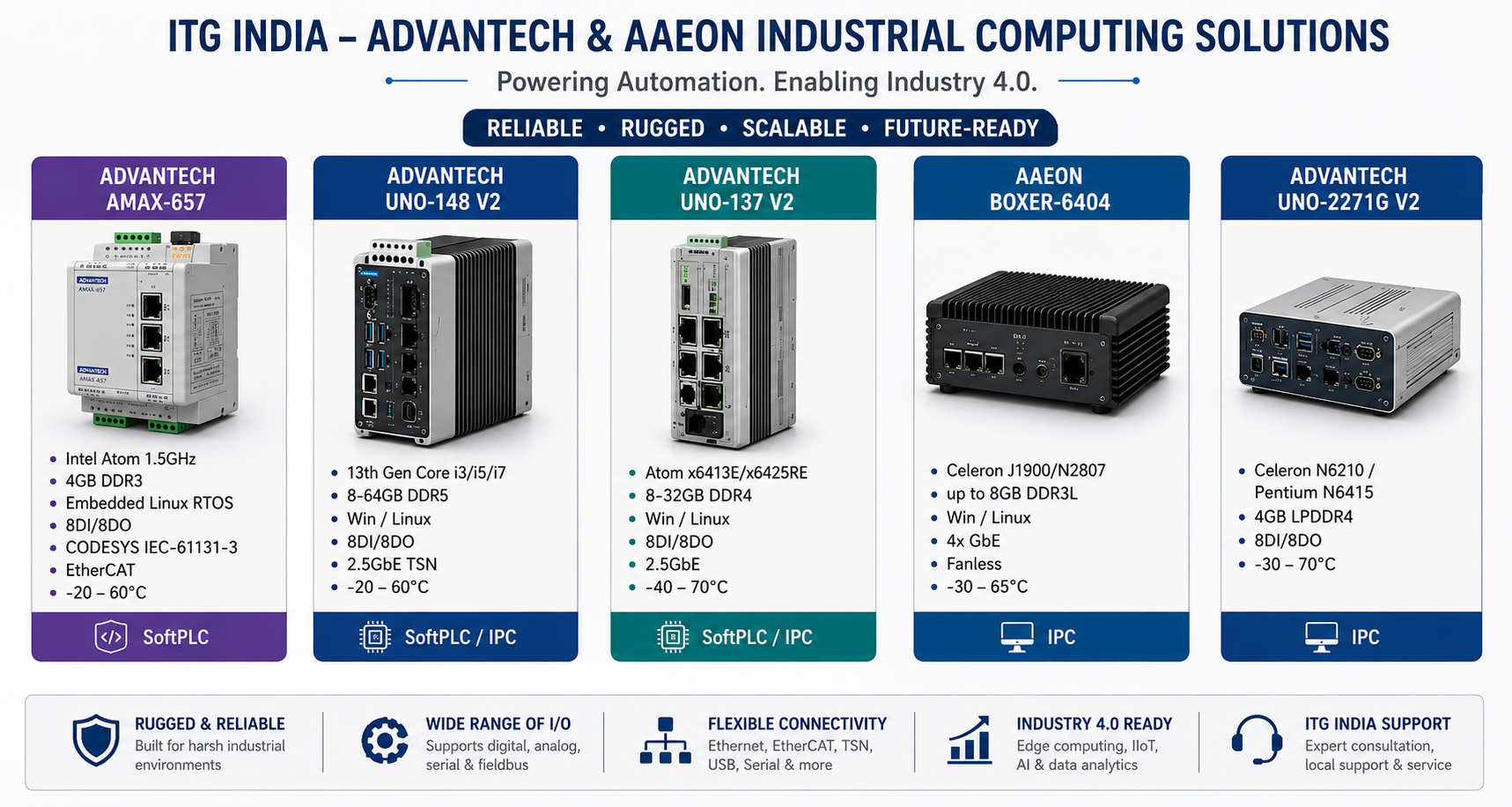
| Role | Product | Key Specs |
|---|---|---|
| SoftPLC | Advantech AMAX-657 | Atom 1.5GHz, Linux RTOS, EtherCAT, CODESYS |
| SoftPLC/IPC | Advantech UNO-148 V2 | 13th Gen Intel Core, DDR5, TSN, 2.5GbE |
| SoftPLC/IPC | Advantech UNO-137 V2 | Atom x6413E, Wide Temp, DIN-rail IPC |
| IPC | AAEON BOXER-6404 | Fanless, 4xGbE, Windows/Linux |
| IPC | Advantech UNO-2271G V2 | Industrial edge controller, 8DI/8DO |
Product Capability Matrix
| Criteria | AMAX-657 | UNO-148 V2 | UNO-137 V2 | BOXER-6404 | UNO-2271G V2 |
|---|---|---|---|---|---|
| RTOS Support | ✓ | ✓ | ✓ | – | – |
| CODESYS SoftPLC | ✓ | ✓ | ✓ | – | – |
| DIN-Rail Design | ✓ | ✓ | ✓ | – | ✓ |
| Wide Temperature | ✓ | ✓ | ✓ | ✓ | ✓ |
| AI/Edge Capability | Moderate | Excellent | High | Moderate | Moderate |
| EtherCAT Support | ✓ | ✓ | ✓ | – | – |
| Industrial I/O | ✓ | ✓ | ✓ | – | ✓ |
| Fanless Design | ✓ | ✓ | ✓ | ✓ | ✓ |
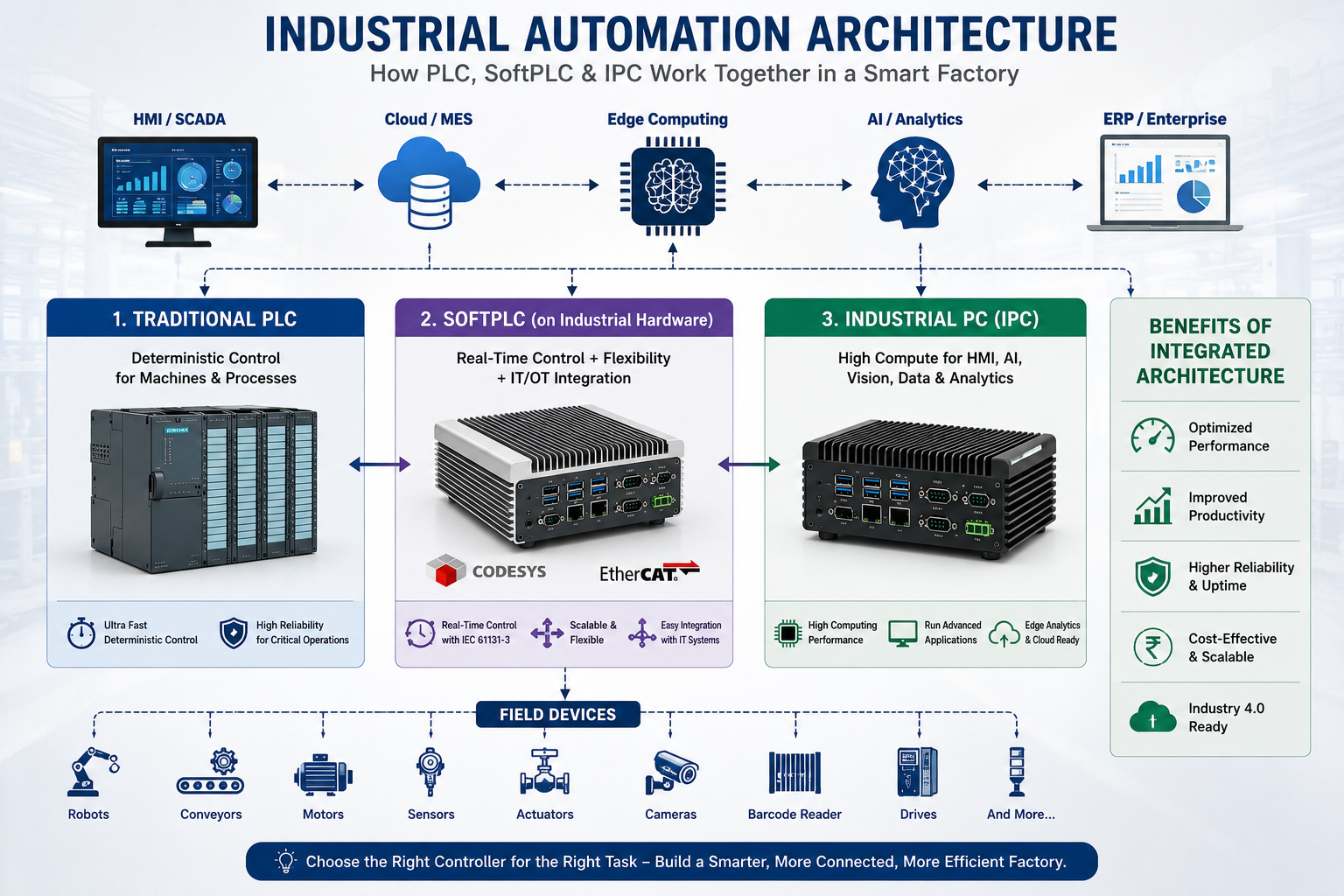
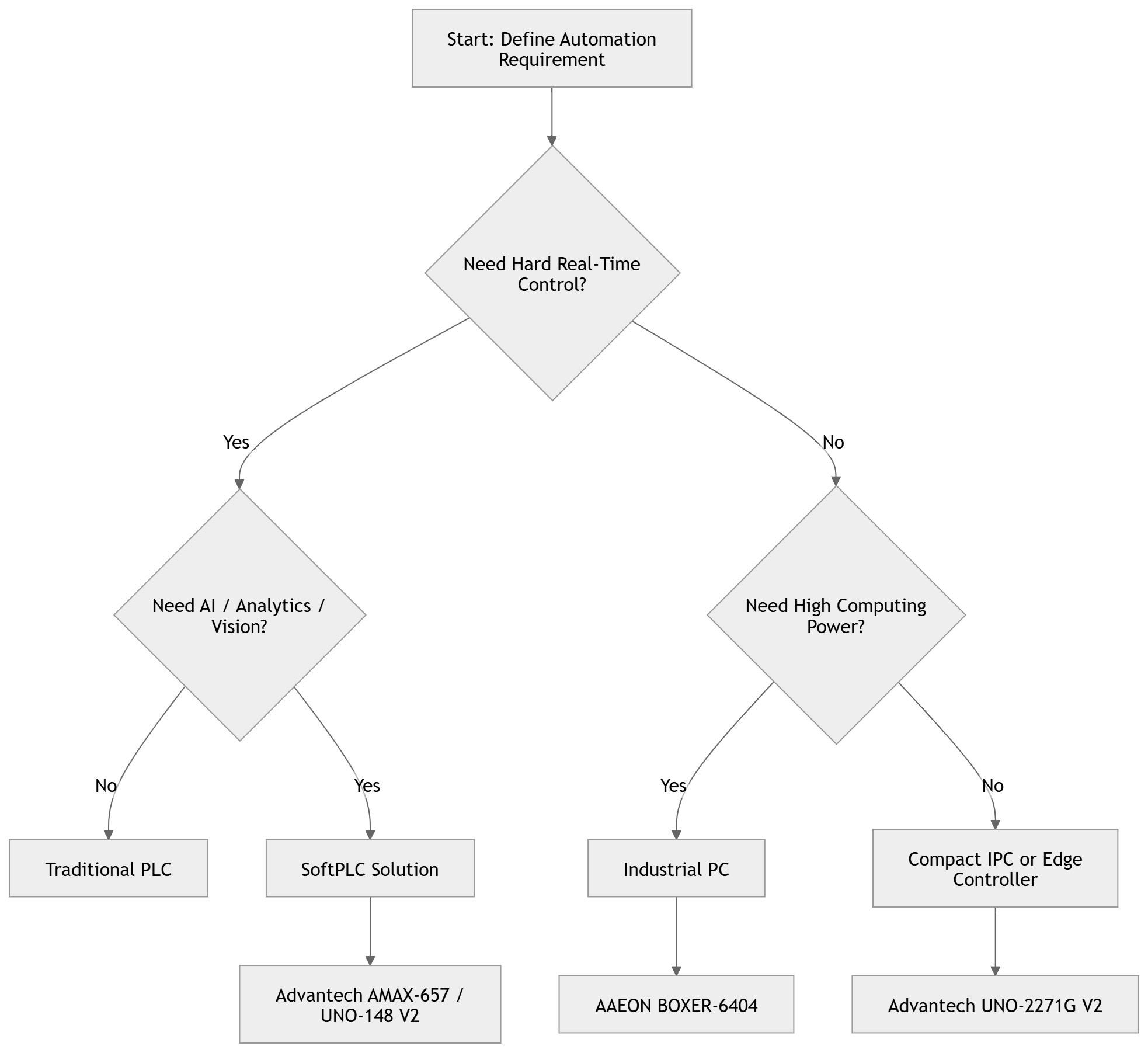
Decision Flowchart
Real-World Industry Example: Indian Factory Modernization
A growing automotive component manufacturer in India recently faced challenges with proprietary PLC expansion costs and delayed spare part availability. The company wanted to integrate predictive maintenance, cloud monitoring, and AI-based defect inspection into its production environment.
Instead of deploying separate PLCs, gateways, and industrial servers, the integrator adopted a SoftPLC architecture using DIN-rail IPC systems.
The result included:
- Reduced hardware footprint
- Faster integration
- Improved supply chain flexibility
- Lower long-term maintenance costs
- Easier Industry 4.0 scalability
This transition reflects a broader trend across Indian manufacturing sectors where companies are increasingly investing in open, scalable, and software-defined automation architectures.
Conclusion
The future of industrial automation is no longer limited to traditional control systems. As factories embrace Industry 4.0, edge computing, AI-driven manufacturing, and real-time analytics, businesses must carefully evaluate the right balance between determinism, flexibility, scalability, and computing performance.
Traditional PLCs continue to excel in ultra-reliable deterministic control environments. Industrial PCs provide unmatched computing flexibility for AI, vision, and edge applications. SoftPLC systems bridge both worlds by combining real-time automation with modern industrial computing power.
For Indian industries seeking cost-effective modernization, improved supply chain resilience, and scalable automation architecture, SoftPLC and IPC-based solutions are becoming increasingly attractive.
ITG India helps manufacturers, OEMs, and system integrators choose the right industrial automation platform with trusted solutions from Advantech and AAEON.
Whether you need a rugged industrial PC, a scalable SoftPLC, or a reliable edge controller for Industry 4.0 deployments, ITG India can help you design the right automation architecture for long-term operational success.