
PoE Switches in Industrial IoT and Automation: Deep-Dive Use Cases, Architecture, and Business Impact
The Industrial Internet of Things (IIoT) is transforming how factories, utilities, transportation networks, and cities operate. Sensors, cameras, controllers, and edge devices now generate continuous streams of data that drive automation, predictive maintenance, and real-time decision-making. However, one challenge consistently limits large-scale IIoT adoption: power and connectivity complexity.
This is where Power over Ethernet-enabled industrial switching infrastructure plays a critical role.
By delivering both power and data through a single Ethernet cable, Power over Ethernet (PoE) fundamentally simplifies industrial network design. In harsh, distributed, and remote environments, industrial-grade Ethernet switches with PoE capability eliminate separate power wiring, reduce installation costs, and enable scalable automation architectures that are easier to deploy, manage, and expand.
This blog explores how PoE switches enable industrial IoT, real-world automation use cases, industries served, and why PoE is now a strategic infrastructure decision, not just a networking convenience.
Table Of Contents
- Understanding PoE-Enabled Ethernet Switching in an Industrial Context
- Why Industrial PoE Switches Are Essential for IIoT
- Industrial Use Cases Enabled by PoE-Based Ethernet Infrastructure
- Industries Served by Industrial PoE-Enabled Ethernet Infrastructure
- Cost Efficiency: Why POE Ethernet Switch Reduce Total Cost of Ownership
- Choosing the Right Industrial PoE Switch
- Conclusion: PoE Switches as an Automation Enabler
Understanding PoE-Enabled Ethernet Switching in an Industrial Context
A PoE-enabled Ethernet switch supplies electrical power and Ethernet data simultaneously to connected devices using standard twisted-pair cabling (Cat5e/Cat6). While PoE is common in enterprise offices, industrial PoE-enabled switches are purpose-built for demanding operational environments.
Unlike commercial switches, industrial-grade Ethernet switches with PoE capability are engineered for:
- Continuous 24/7 operation
- Wide temperature ranges (often -40°C to +75°C)
- Electrical noise and vibration
- Redundant power inputs
- DIN-rail or industrial rack mounting
This makes them suitable for factory floors, substations, roadside cabinets, oil fields, and outdoor enclosures, where traditional power infrastructure is difficult or expensive to deploy.
PoE-enabled industrial switching platforms are widely used in IIoT architectures to support edge devices that must operate reliably with minimal downtime.
Why Industrial PoE Switches Are Essential for IIoT
Industrial IoT environments differ significantly from office networks. Devices are often:
- Spread across large physical areas
- Installed in hard-to-reach or hazardous locations
- Frequently reconfigured as processes evolve
- Required to operate without interruption
Traditional power delivery methods add cost, complexity, and multiple failure points. PoE-based industrial networking directly addresses these challenges.
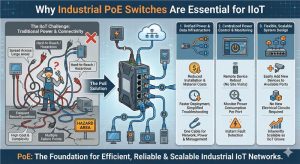
1. Unified Power and Data Infrastructure
PoE eliminates the need for separate electrical wiring. A single Ethernet cable provides:
- Network connectivity
- Regulated DC power
- Centralized power management
This unified approach reduces installation time, lowers material costs, and simplifies troubleshooting
2. Centralized Power Control and Monitoring
With industrial PoE networking in place, power delivery can be managed centrally from the network layer. Industrial operators can:
- Remotely reboot connected devices
- Monitor power consumption per port
- Detect faults without site visits
This is especially valuable in large IIoT deployments where manual intervention is costly or unsafe.
3. Flexible, Scalable System Design
As IIoT deployments grow, new sensors, cameras, or access points can be added simply by connecting them to available PoE ports. No new electrical circuits are required, making PoE inherently scalable.
Industrial Use Cases Enabled by PoE-Based Ethernet Infrastructure
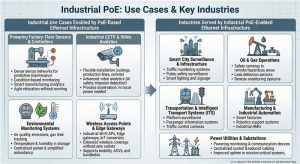
1.Powering Factory-Floor Sensors and Controllers
Modern factories rely on dense networks of sensors to monitor:
- Temperature and humidity
- Vibration and machine health
- Pressure, flow, and energy consumption
Using PoE-enabled industrial Ethernet switches, these sensors can be deployed anywhere Ethernet cabling reaches – without additional power infrastructure. This is particularly valuable for:
- Predictive maintenance systems
- Condition-based monitoring
- Smart manufacturing analytics
As production layouts change, sensors can be relocated or added without rewiring, supporting agile manufacturing strategies.
2. Industrial CCTV and Video Analytics
CCTV cameras are among the most common PoE-powered devices in industrial environments. With industrial PoE networking in place, cameras can be installed:
- On factory ceilings
- Along production lines
- At remote perimeter locations
PoE enables not only video transmission but also advanced video analytics, including AI-based safety monitoring, intrusion detection, and process observation-without requiring local power sources.
3. Environmental Monitoring Systems
Industrial sites often require continuous environmental monitoring for compliance and safety. Industrial PoE-enabled network switches support sensors that track:
- Air quality and emissions
- Temperature and humidity in storage facilities
- Gas leaks in oil & gas operations
Centralized power delivery ensures these systems remain operational during network-managed power events and simplifies redundancy planning.
4. Wireless Access Points and Edge Gateways
Wireless connectivity is a cornerstone of IIoT, particularly in mobile or flexible operations. PoE-capable industrial Ethernet devices power:
- Industrial Wi-Fi access points
- Edge computing gateways
- IoT protocol converters
This allows wireless coverage to be extended across large facilities without installing additional power outlets, supporting mobility, AGVs, and handheld devices.
Industries Served by Industrial PoE-Enabled Ethernet Infrastructure
1. Smart City Surveillance and Infrastructure
Smart cities depend on distributed devices such as cameras, traffic sensors, and environmental monitors. PoE-based industrial Ethernet systems enable large-scale deployment of these devices with reduced civil and electrical work.
Applications include:
- Traffic monitoring systems
- Public safety surveillance
- Smart lighting and signage
2. Oil & Gas Operations
Oil and gas facilities operate in remote, hazardous environments where power access is limited. PoE simplifies deployment of:
- Safety cameras
- Leak detection sensors
- Remote monitoring systems
By reducing electrical wiring, PoE also improves safety and lowers installation risk.
3. Transportation and Intelligent Transport Systems (ITS)
Railways, highways, and airports rely on networked devices for operational safety and efficiency. PoE-enabled industrial Ethernet solutions:
- Platform surveillance
- Passenger information systems
- Traffic control cameras
Their rugged design ensures reliability in vibration-prone and outdoor environments.
4. Manufacturing and Industrial Automation
Manufacturing remains the largest adopter of PoE in IIoT, where scalable and reliable automation solutions are critical for operational efficiency and uptime. From assembly lines to warehouses, industrial Ethernet PoE infrastructure supports:
- Smart factories
- Robotics support systems
- Industrial HMIs
They enable automation systems that are both scalable and resilient.
5. Power Utilities and Substations
Utilities use PoE-enabled industrial Ethernet platforms to power monitoring and communication devices in substations and distribution networks. Benefits include centralized control, reduced cabling, and improved uptime in mission-critical systems.
Cost Efficiency: Why POE Ethernet Switch Reduce Total Cost of Ownership
One of the most overlooked advantages of PoE-based industrial Ethernet networking is its ability to lower the total cost of ownership for enterprise-scale automation solutions.
1. Reduced Installation Costs
- No separate electrical wiring
- Fewer components and contractors
- Faster deployment timelineser Maintenance and Downtime
2. Lower Maintenance and Downtime
- Centralized power resets
- Fewer failure points
- Remote troubleshooting capabilities
3. Energy Efficiency
Modern PoE standards deliver power only when required, reducing wasted energy and supporting sustainability goals.
4. Scalability: Preparing for Future IIoT Growth
Industrial automation is not static. As digital transformation accelerates, networks must support:
- More devices
- Higher data volumes
- Edge AI and analytics
PoE-based industrial Ethernet architectures are inherently future-ready. Additional devices can be integrated without redesigning power infrastructure, making PoE a strategic foundation for long-term IIoT scalability.
Choosing the Right Industrial PoE Switch
Evaluating factors such as power budget, redundancy, and environmental tolerance helps organizations select the right POE Ethernet Switch for their specific automation requirements:
- PoE power budget per port
- Environmental ratings and certifications
- Redundant power and network paths
- Mounting and form-factor requirements
Industrial-grade PoE solutions-such as those available from ITG India-are designed specifically to meet these operational demands and support mission-critical automation systems.
Conclusion: PoE Switches as an Automation Enabler
PoE is no longer just a networking feature-it is a core enabler of modern industrial automation and scalable automation solutions. By simplifying power delivery, reducing infrastructure complexity, and enabling scalable IIoT architectures, poe switches help industrial organizations build smarter, safer, and more efficient systems.
Across smart cities, oil & gas, transportation, manufacturing, and power utilities, PoE switches provide the reliability and flexibility required for next-generation automation. For industrial owners planning long-term digital transformation, PoE is not an optional upgrade-it is foundational infrastructure.

