SCADA System Architecture: Building Reliable Industrial Networks with Industrial Ethernet Switches and Remote I/O
Table of Contents
- Introduction
- What Is a SCADA System?
- Core Components of a Modern SCADA System
- Why Industrial Networking Is Critical for SCADA Systems
- Building a Reliable SCADA Network with Advantech EKI Industrial Ethernet Switches
- SCADA Communication Protocols: The Language of Industrial Automation
- Modern Data Acquisition with Advantech ADAM Remote I/O Modules
- Fiber Connectivity for Large-Scale SCADA Deployments
- SCADA Cybersecurity Best Practices
- SCADA and Industry 4.0: The Future of Industrial Automation
- Conclusion
Introduction
In today’s industrial landscape, a SCADA System is no longer just a monitoring platform-it has become the foundation of intelligent automation, operational efficiency, and real-time decision-making. Industries such as manufacturing, power generation, water treatment, oil & gas, mining, and infrastructure management rely on SCADA systems to monitor assets, control processes, and collect critical operational data.
However, many discussions about SCADA focus only on software, dashboards, and PLCs while overlooking the network infrastructure and field connectivity that make industrial automation possible. A modern SCADA system depends on reliable communication protocols, industrial Ethernet switches, remote I/O modules, and secure data acquisition networks to ensure seamless operations.
In this guide, we explore how modern SCADA architectures are built and how industrial networking solutions such as Advantech EKI Industrial Ethernet Switches and ADAM Remote I/O Modules help organizations create reliable, scalable, and future-ready automation systems.
What Is a SCADA System?
SCADA stands for Supervisory Control and Data Acquisition. It is an industrial automation system designed to monitor, control, and collect data from equipment distributed across a facility or multiple remote locations.
A SCADA system enables operators to:
- Monitor equipment performance in real time
- Control industrial processes remotely
- Generate alarms and notifications
- Collect historical operational data
- Improve process efficiency
- Reduce downtime and maintenance costs
The primary objective of a SCADA system is to provide complete visibility and control over industrial operations while ensuring safe and reliable performance.
Core Components of a Modern SCADA System
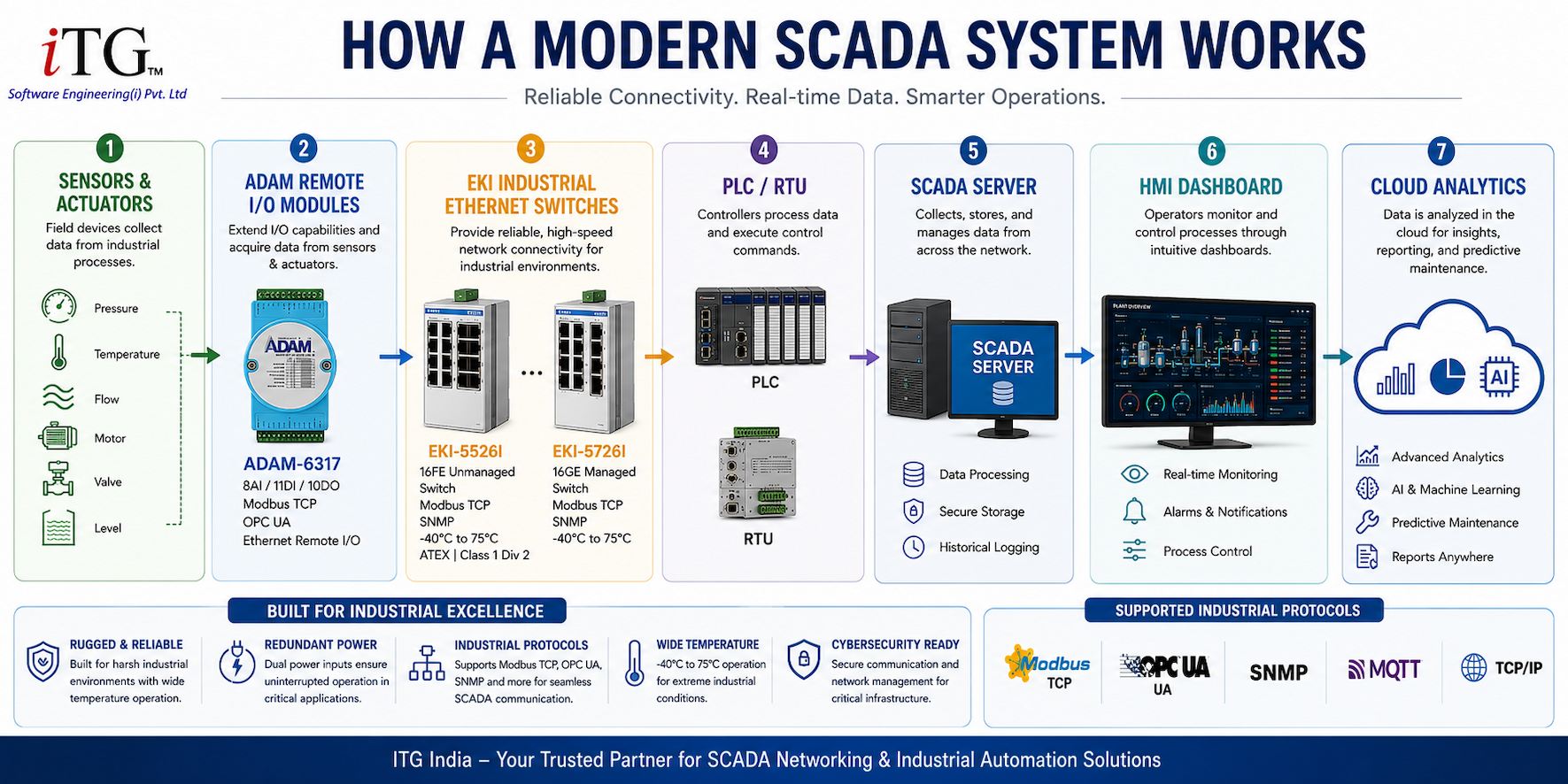
Every SCADA architecture consists of multiple interconnected components working together to create a unified automation ecosystem.
Sensors and Field Devices
Sensors continuously collect operational information such as pressure, temperature, flow rate, voltage, current, vibration, and humidity.
PLCs and RTUs
PLCs and RTUs collect data from sensors, process information, and execute control commands within a SCADA system. While PLCs are widely used in industrial automation for fast and reliable control, RTUs are ideal for monitoring remote assets. To understand how PLCs compare with other industrial controllers, read our guide on PLC vs IPC vs SoftPLC.
Industrial Communication Network
The communication network connects field devices with central control systems. This layer includes industrial Ethernet switches, fiber-optic networks, wireless communication systems, and industrial protocols.
Wireless I/O Modules
Wireless I/O modules extend connectivity across industrial facilities, allowing sensors and actuators to communicate with SCADA platforms without extensive wiring infrastructure. They simplify data acquisition, improve flexibility, and support remote monitoring applications. To learn more about their role in automation, read our guide on What is an I/O Module and Its Crucial Role in Industrial Automation.
SCADA Server and HMI
The SCADA server processes operational data, while Human Machine Interfaces (HMIs) provide visual dashboards for monitoring and control.
Why Industrial Networking Is Critical for SCADA Systems
A SCADA system is only as reliable as the network infrastructure supporting it.
Industrial environments often expose networking equipment to extreme temperatures, electrical noise, dust, moisture, vibration, and power fluctuations. Traditional commercial networking hardware cannot consistently withstand these conditions.
This is where industrial Ethernet switches become essential.
Industrial Ethernet switches provide:
- High network reliability
- Rugged environmental protection
- Redundant power capabilities
- Industrial protocol support
- Extended temperature operation
- Long-term network stability
Without robust industrial networking infrastructure, data loss, communication delays, and unexpected downtime can compromise critical operations.
Building a Reliable SCADA Network with Advantech EKI Industrial Ethernet Switches
Industrial Ethernet switches serve as the backbone of modern SCADA architectures by enabling communication between PLCs, RTUs, HMIs, servers, and field devices.
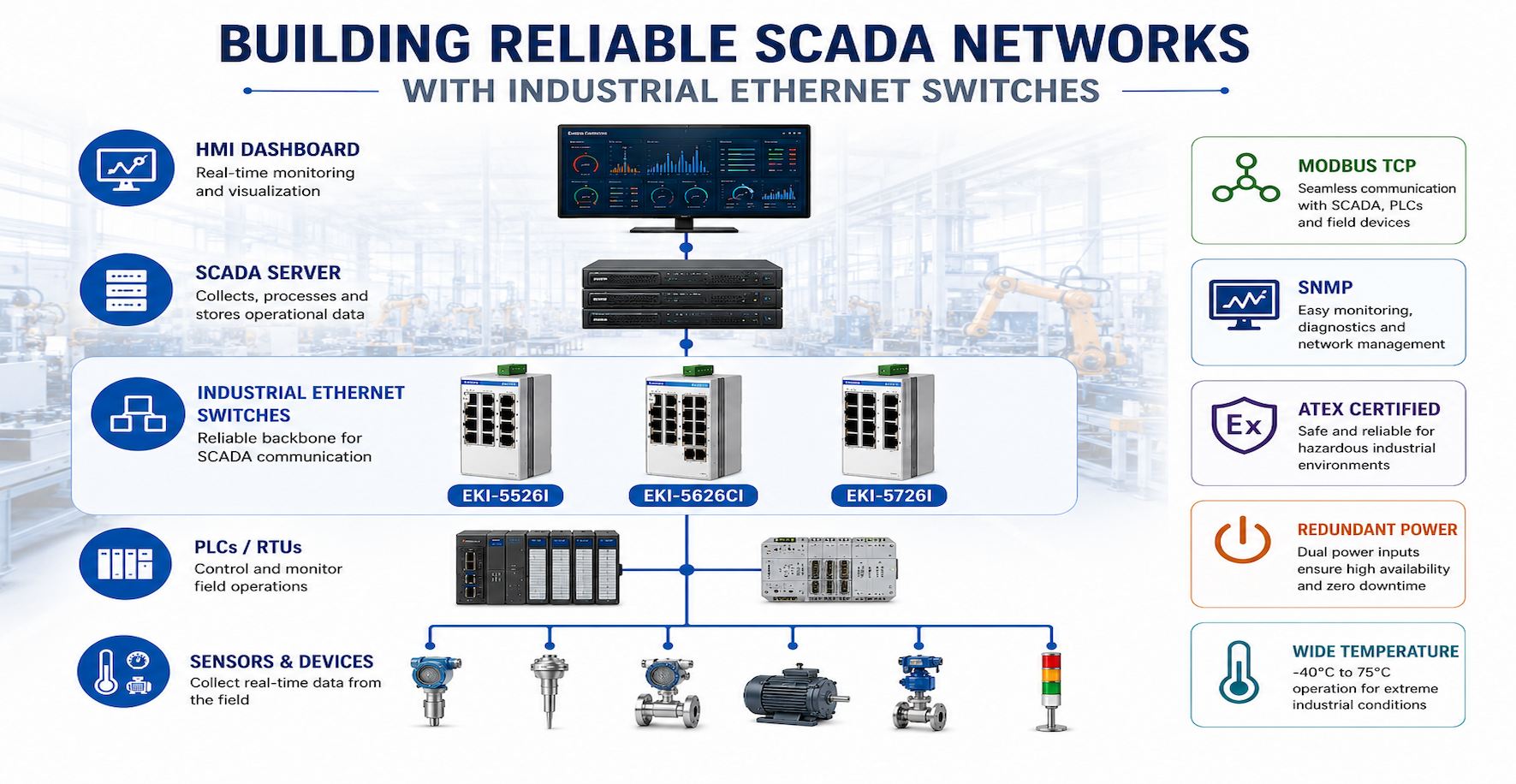
Advantech EKI-5526I Industrial Ethernet Switch
The Advantech EKI-5526I is designed for demanding industrial environments and supports Modbus/TCP communication for SCADA connectivity.
Key advantages include:
- 16 Fast Ethernet ports
- ATEX and Class 1 Division 2 certification
- Wide operating temperature range from -40°C to 75°C
- Redundant power inputs
- SNMP network management support
These capabilities make it suitable for industrial automation, utilities, and process control applications.
Advantech EKI-5726I Gigabit Industrial Switch
For applications requiring higher bandwidth and faster data transmission, the EKI-5726i delivers Gigabit Ethernet performance while maintaining industrial-grade reliability.
This makes it ideal for:
- Manufacturing plants
- Smart factories
- Utility networks
- Process automation systems
Advantech EKI-5729PI Industrial PoE Switch
As industrial facilities adopt IP cameras, wireless access points, and edge computing devices, Power over Ethernet becomes increasingly valuable.
The EKI-5729PI provides:
- Eight PoE-enabled Gigabit ports
- Simplified installation
- Reduced cabling requirements
- Improved deployment flexibility
PoE technology enables both power and data transmission through a single Ethernet cable, reducing infrastructure complexity.
SCADA Communication Protocols: The Language of Industrial Automation
Communication protocols determine how data moves throughout a SCADA system.
Choosing the right protocol directly impacts system performance, scalability, security, and interoperability.
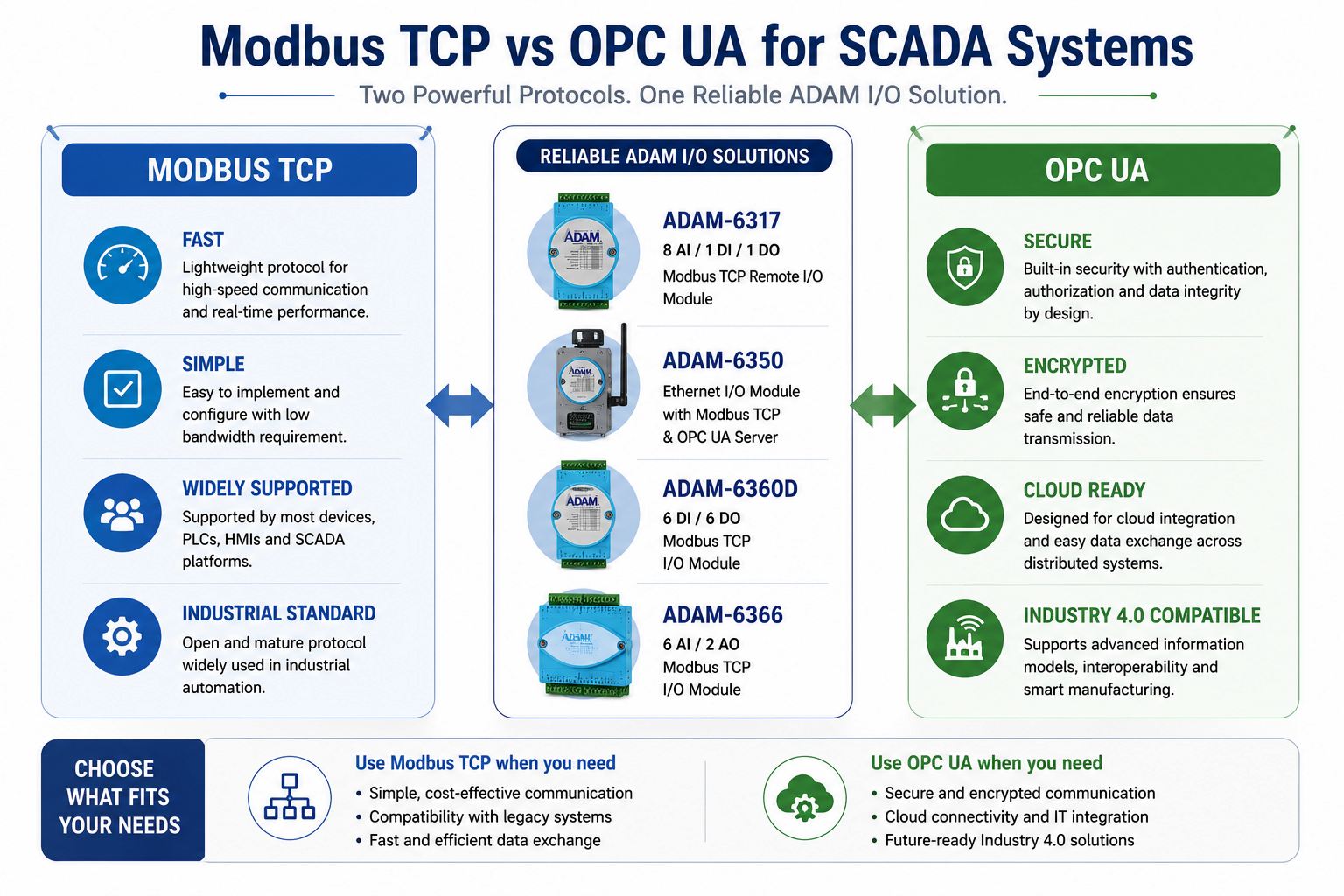
Modbus TCP
Modbus TCP remains one of the most widely adopted industrial communication protocols.
Benefits include:
- Simplicity
- Broad compatibility
- Fast implementation
- Reliable communication
Many industrial switches and field devices rely on Modbus TCP to exchange operational data with SCADA platforms.
OPC UA
As industrial systems become increasingly connected, OPC UA has emerged as a preferred protocol for modern automation environments.
OPC UA provides:
- Secure communication
- Data encryption
- Platform independence
- Cloud integration capabilities
- Enhanced interoperability
Unlike traditional protocols, OPC UA supports advanced data modeling and seamless integration with Industrial IoT platforms.
MQTT and Industrial IoT
MQTT enables lightweight communication between edge devices, cloud applications, and SCADA systems.
Organizations implementing Industry 4.0 initiatives often use MQTT to connect operational technology with enterprise-level analytics platforms.
Modern Data Acquisition with Advantech ADAM Remote I/O Modules
Data acquisition is one of the most important functions within a SCADA system.
Advantech ADAM Remote I/O Modules simplify the process of collecting operational data from distributed industrial assets.
ADAM-6317
The ADAM-6317 combines analog inputs, digital inputs, and digital outputs within a single compact device.
It supports:
- Modbus TCP
- OPC UA
- Secure industrial communication
- SCADA integration
ADAM-6350
The ADAM-6350 provides high-density digital input and output capabilities, making it ideal for monitoring and controlling multiple field devices simultaneously.
ADAM-6360D and ADAM-6366
These modules provide relay-based control functions while supporting industrial communication standards required by modern SCADA architectures.
By incorporating OPC UA functionality, ADAM modules bridge traditional automation systems with Industrial IoT and cloud-based applications.
Fiber Connectivity for Large-Scale SCADA Deployments
Many industrial operations span large geographical areas where traditional copper cabling becomes impractical.
Examples include:
- Electrical substations
- Water distribution networks
- Oil pipelines
- Mining operations
The Advantech EKI-5525SI-ST Industrial Ethernet Switch incorporates a single-mode fiber port, enabling long-distance communication while maintaining signal integrity and resistance to electromagnetic interference.
Benefits of fiber connectivity include:
- Longer transmission distances
- Increased reliability
- Improved cybersecurity
- Enhanced network performance
For critical infrastructure projects, fiber often becomes the preferred communication medium.
SCADA Cybersecurity Best Practices
Cybersecurity has become one of the most important considerations in industrial automation.
As SCADA systems connect to cloud services, enterprise networks, and remote facilities, the attack surface expands significantly.
Organizations should implement:
Network Segmentation
Separate operational technology networks from corporate IT systems.
Secure Protocols
Use secure communication standards such as OPC UA with encryption capabilities.
Continuous Monitoring
Implement SNMP-based monitoring tools to maintain visibility into network performance and security.
Access Control
Restrict system access using role-based permissions and multi-factor authentication.
Security Standards
Organizations should align with standards such as:
- IEC 62443
- NIST SP 800-82
- ISA-95
These frameworks help establish robust industrial cybersecurity programs.
SCADA and Industry 4.0: The Future of Industrial Automation
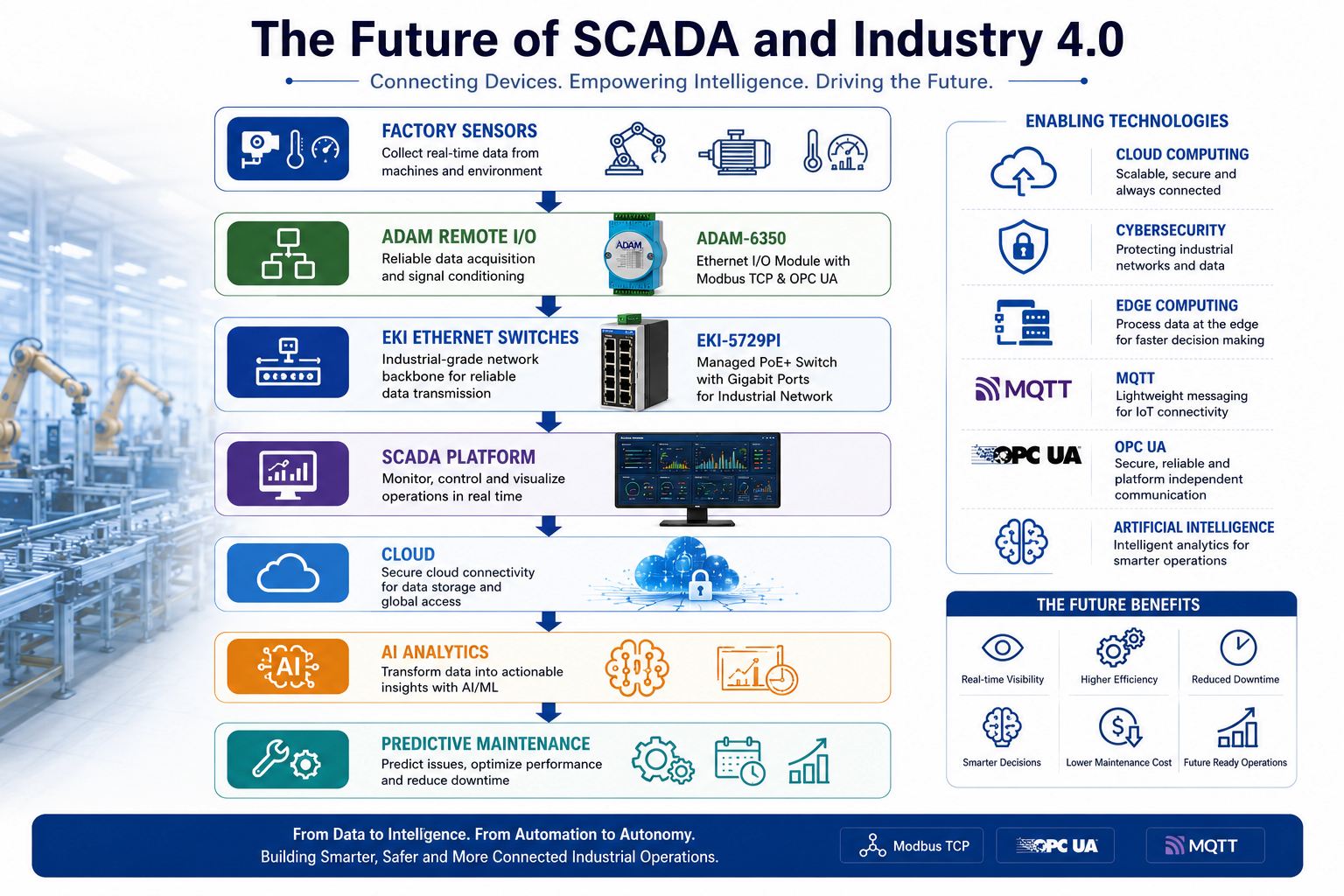
Industrial automation is evolving rapidly.
Modern SCADA systems now integrate:
- Industrial IoT devices
- Edge computing platforms
- Cloud analytics
- Artificial intelligence
- Predictive maintenance solutions
With industrial Ethernet switches and intelligent remote I/O devices acting as the connectivity layer, organizations can transform operational data into actionable business intelligence.
The convergence of SCADA, OPC UA, MQTT, edge computing, and AI is creating smarter, more efficient industrial environments capable of responding to changing operational conditions in real time.
Conclusion
A SCADA system is much more than software and dashboards. Reliable industrial automation depends on secure communication protocols, resilient networking infrastructure, intelligent remote I/O devices, and scalable architectures that support future growth.
Industrial Ethernet switches such as the Advantech EKI Series and remote I/O solutions like the Advantech ADAM Series provide the connectivity, reliability, and flexibility required to build modern SCADA networks. Whether deploying automation in manufacturing, utilities, oil & gas, water treatment, or critical infrastructure, investing in the right networking and data acquisition technologies is essential for achieving long-term operational success.
As industries continue embracing digital transformation and Industry 4.0, organizations that build robust SCADA foundations today will be better positioned to achieve greater efficiency, reliability, and competitiveness tomorrow.