
Types of Industrial Ethernet Switches: How to Choose the Right One
Table of Contents
- What Is an Industrial Ethernet Switch?
- Main Types of Industrial Ethernet Switches
- Managed vs Unmanaged Ethernet Switch: Which One Should You Choose?
- Industrial Ethernet Switch vs Commercial Ethernet Switch
- Layer 2 vs Layer 3 Industrial Ethernet Switches
- What Ethernet Speed and Port Type Do You Need?
- How to Choose the Right Industrial Ethernet Switch
- Choosing a Switch by Industrial Application
- Common Mistakes When Selecting an Industrial Ethernet Switch
- Final Thoughts
Reliable communication is essential in modern industrial automation. PLCs, HMIs, SCADA systems, sensors, industrial computers, IP cameras and edge devices continuously exchange data, and the network connecting these devices needs to remain stable even under demanding operating conditions.
This is where an industrial Ethernet switch becomes an important part of the network infrastructure.
Unlike standard office networking equipment, industrial Ethernet switches are designed for environments where temperature changes, vibration, electrical interference and continuous operation can affect network reliability. However, not every industrial application requires the same type of switch.
Some networks need simple plug-and-play connectivity, while others require traffic control, redundancy, remote monitoring or Power over Ethernet. Understanding the different types of switches can therefore help engineers, OEMs, system integrators and plant operators select the right solution for their applications.
What Is an Industrial Ethernet Switch?
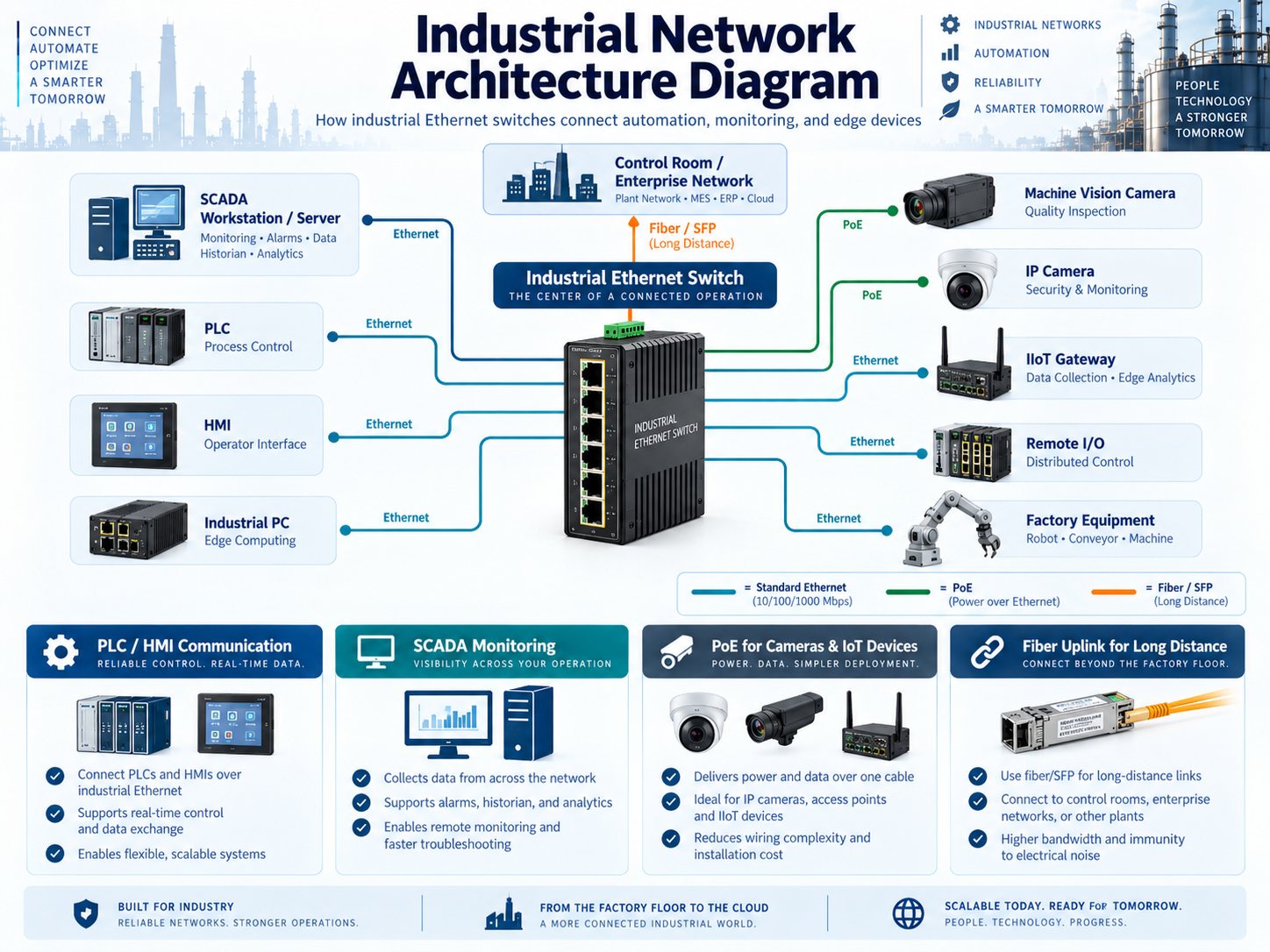
An industrial Ethernet switch connects multiple Ethernet-enabled devices within an industrial network and allows data to move efficiently between them.
Typical connected equipment may include:
- PLCs
- HMIs
- SCADA systems
- Industrial PCs
- Remote I/O
- IP cameras
- Sensors
- IoT gateways
- Machine vision systems
Compared with a conventional commercial switch, an industrial network switch is generally designed for long-term operation in demanding environments. Depending on the model and application, features may include rugged construction, wide operating-temperature support, redundant power inputs, DIN-rail installation and industrial communication capabilities.
Businesses building factory, utility, transportation or IIoT networks can explore ITG India’s Industrial Ethernet Switches to compare solutions for different automation requirements.
Main Types of Industrial Ethernet Switches
Industrial switches can be grouped according to how much network control they provide and the functions they support.
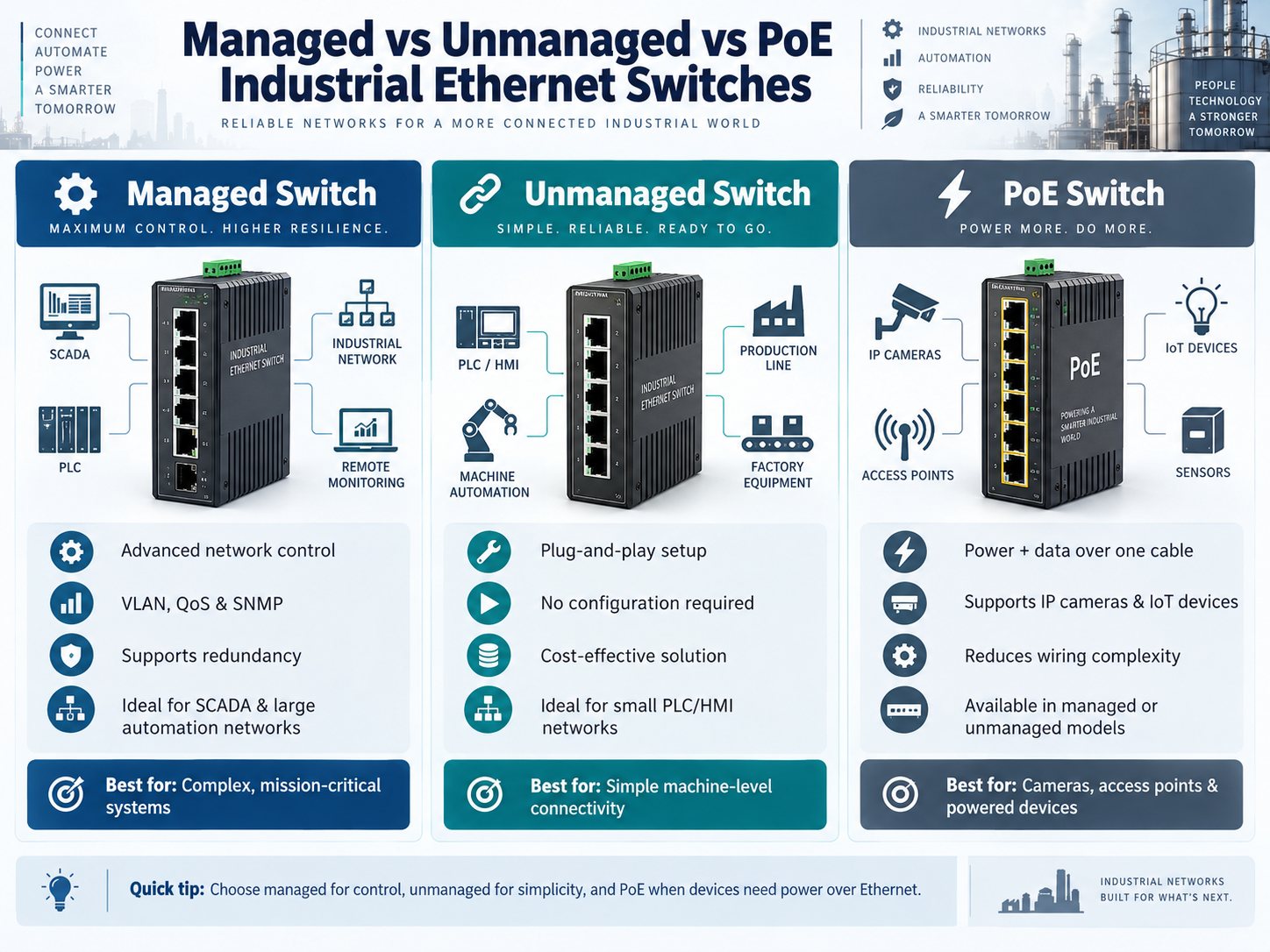
1. Unmanaged Industrial Ethernet Switch
An unmanaged Ethernet switch provides straightforward Ethernet connectivity without requiring network configuration.
It is generally plug-and-play: connect the devices and cables, supply power and the switch begins forwarding Ethernet traffic.
An unmanaged industrial switch can be suitable for:
- Small PLC and HMI networks
- Standalone machinery
- Simple production lines
- Small control cabinets
- Networks that do not require VLAN or advanced monitoring
The main advantages are easy deployment, lower configuration requirements and straightforward maintenance.
For uncomplicated industrial networks, ITG India’s Unmanaged Ethernet Switches provide options ranging from compact Ethernet switches to Gigabit and fiber-enabled industrial models.
2. Managed Industrial Ethernet Switch
A managed Ethernet switch gives network administrators significantly greater visibility and control.
Depending on the model, managed switches can support functions such as VLANs, QoS, SNMP, diagnostics, traffic management and network redundancy.
A managed industrial switch is generally more appropriate when the network is larger, business-critical or needs to be monitored centrally.
For example, a manufacturing facility may need to separate automation traffic, CCTV traffic and other network devices. VLAN functionality allows the network to be logically segmented instead of placing every connected device in the same broadcast domain.
Managed switches can be useful for:
- SCADA networks
- Large manufacturing plants
- Process automation
- Power and energy networks
- Transportation systems
- Networks requiring redundancy
- Applications requiring remote diagnostics
ITG India’s Managed Ethernet Switches can be considered when advanced network control, reliability and scalability are important.
3. PoE Industrial Ethernet Switch
A PoE Ethernet switch transmits power and network data over the same Ethernet cable to compatible devices.
This can reduce separate electrical wiring requirements for equipment such as:
- IP cameras
- Wireless access points
- Industrial IoT devices
- Access-control equipment
- Networked sensors
- Monitoring devices
PoE can be particularly useful where installing a separate power connection near each device would be expensive or inconvenient.
However, buyers should not select a PoE switch only according to port count. The required PoE standard, total power budget and power requirements of the connected devices should also be evaluated.
For applications requiring combined data and power connectivity, explore ITG India’s Industrial PoE Ethernet Switches. For a deeper technical explanation, also see the PoE Switches in Industrial IoT and Automation Guide.
Managed vs Unmanaged vs PoE Industrial Ethernet Switches: Quick Comparison
Managed vs Unmanaged Ethernet Switch: Which One Should You Choose?
One of the most common decisions is whether an industrial network requires a managed or unmanaged switch.
| Requirement | Unmanaged Switch | Managed Switch |
|---|---|---|
| Plug-and-play installation | Yes | Configuration normally required |
| Basic PLC/HMI connection | Yes | Yes |
| VLAN support | No | Yes |
| Advanced network monitoring | Limited | Yes |
| QoS and traffic control | No | Yes |
| Network redundancy | Limited | Available on suitable models |
| Large network scalability | Limited | Better suited |
| Simple standalone machine | Ideal | May be unnecessary |
| Mission-critical network | Limited | Recommended where appropriate |
For a small machine with several Ethernet devices, an unmanaged switch may provide everything required.
For a factory-wide SCADA or automation network where downtime and troubleshooting are important considerations, a managed switch usually provides more control.
Industrial Ethernet Switch vs Commercial Ethernet Switch
Although both devices perform Ethernet switching, their intended environments are different.
Commercial network switches are generally designed for controlled spaces such as offices, server rooms and commercial buildings.
Industrial Ethernet switches are designed for more demanding operating environments.
Important differences can include:
Operating Environment
Factories, transportation systems, power installations and outdoor cabinets can experience temperature fluctuations, vibration, dust and electrical interference that may not be present in an office.
Power Reliability
Industrial networks may require redundant power inputs so that another supply can maintain network operation if one power source is interrupted.
Installation
Compact DIN-rail switches are common inside industrial control cabinets, while larger installations may use rack-mounted switches.
Continuous Operation
Production networks frequently operate around the clock. Network equipment must therefore be selected according to the reliability requirements of the application rather than only purchase price.
Layer 2 vs Layer 3 Industrial Ethernet Switches
Another consideration is the networking layer at which the switch needs to operate.
Layer 2 Ethernet Switch
Layer 2 switches primarily forward Ethernet frames using MAC addresses.
They are suitable for many industrial LAN applications where connected devices operate within the same network or VLAN environment.
Layer 3 Ethernet Switch
A Layer 3 switch provides additional routing capabilities and can help route traffic between different VLANs or network segments.
Layer 3 functionality becomes more relevant as automation networks become larger and contain multiple logical network segments.
For a simple machine-level network, Layer 3 functionality may be unnecessary. For larger industrial infrastructure, however, it can provide greater network flexibility.
What Ethernet Speed and Port Type Do You Need?
Selecting the correct switch also requires checking bandwidth, port numbers and connection type.
Fast Ethernet vs Gigabit Ethernet
Traditional control applications may generate relatively small amounts of network traffic, while machine vision systems, surveillance cameras and edge computing applications can transmit significantly more data.
A Gigabit Ethernet switch can therefore be preferable where higher bandwidth, multiple data-intensive devices or future network growth are expected.
RJ45 vs Fiber and SFP
Copper RJ45 Ethernet connections are widely used for short-distance device connectivity.
Fiber connections can be useful when greater transmission distances, electrical isolation or connectivity between different areas of a facility are required.
Switches with SFP slots provide additional flexibility by allowing suitable fiber transceiver modules to be selected according to the network.
Where an existing copper Ethernet network must connect to fiber infrastructure, ITG India’s Industrial Media Converters can also be used as part of the connectivity architecture.
How to Choose the Right Industrial Ethernet Switch
Before selecting a switch, evaluate the actual network rather than choosing only according to price or port count.
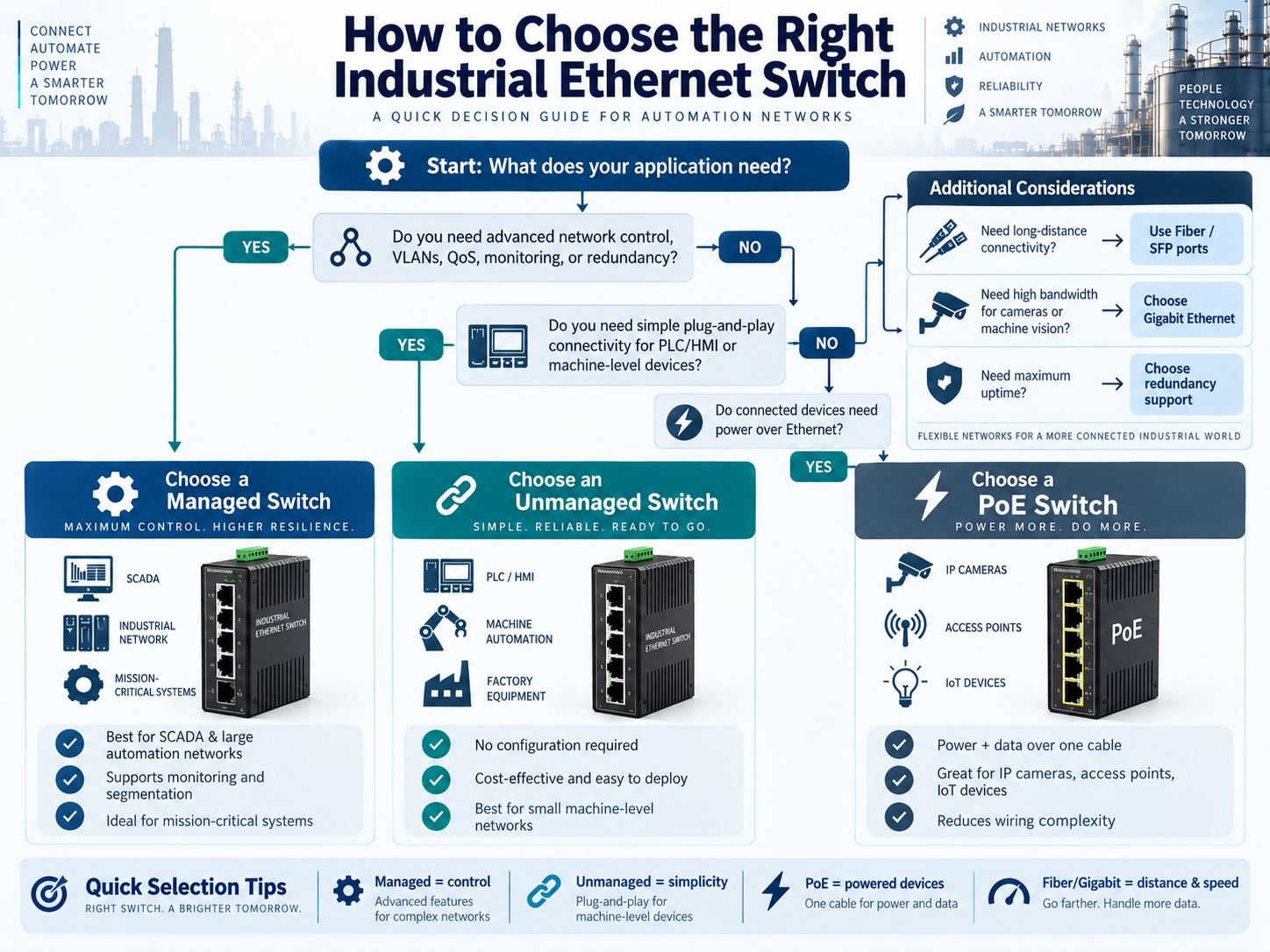
Check the following factors:
- Managed or unmanaged: Determine whether network configuration and monitoring are necessary.
- Port count: Include current devices and capacity for future expansion.
- Network speed: Evaluate Fast Ethernet, Gigabit and higher-bandwidth requirements.
- Copper or fiber: Consider transmission distance and network environment.
- PoE requirement: Identify whether connected devices need Ethernet-delivered power.
- PoE power budget: Calculate the total power required by all powered devices.
- Operating environment: Review temperature, vibration and installation conditions.
- Redundancy: Determine the impact of a network or power failure on operations.
- Network management: Consider VLAN, QoS, monitoring and diagnostic requirements.
- Industrial standards: Verify certifications and technical specifications required by the project.
Choosing a Switch by Industrial Application
Different automation applications create different networking requirements.
PLC and HMI Networks
A compact unmanaged industrial switch may be sufficient for a small PLC/HMI system. Larger production networks may benefit from managed switching and monitoring.
SCADA Systems
SCADA networks often require reliable communication, monitoring and greater control over network traffic. Managed industrial Ethernet switches are commonly considered for these environments.
For additional information about network design, read ITG India’s SCADA System Architecture Guide.
Machine Vision
Industrial cameras can generate large amounts of data. Gigabit Ethernet ports and sufficient uplink capacity should therefore be considered when designing a machine vision network.
Industrial CCTV and Surveillance
Where compatible IP cameras require both connectivity and electrical power, PoE industrial Ethernet switches can simplify installation.
IIoT and Smart Manufacturing
As more sensors, edge gateways and connected devices are added, scalability becomes increasingly important. Selecting sufficient ports, bandwidth and management capability can help avoid premature network upgrades.
Common Mistakes When Selecting an Industrial Ethernet Switch
Several problems can be avoided during the planning stage.
Common mistakes include:
- Using office-grade equipment in demanding industrial environments
- Selecting too few ports for future expansion
- Ignoring bandwidth requirements
- Choosing an unmanaged switch where advanced monitoring is required
- Ignoring fiber connectivity for long-distance links
- Selecting PoE without checking the total power budget
- Overlooking redundant power requirements
- Ignoring environmental ratings or required certifications
- Focusing only on initial cost instead of network reliability
The best industrial Ethernet switch is therefore not necessarily the switch with the largest number of features. It is the switch whose capabilities match the actual network requirements.
Final Thoughts
Industrial automation networks are becoming more connected as PLCs, SCADA platforms, cameras, sensors, industrial computers and IIoT devices exchange increasing amounts of operational data.
Choosing between an unmanaged, managed, PoE, Gigabit, fiber-enabled, Layer 2 or Layer 3 industrial Ethernet switch should be based on network size, environment, bandwidth, management requirements and future scalability.
Small machine networks may only require straightforward unmanaged connectivity, while factory-wide and mission-critical systems can benefit from managed switching, network monitoring and redundancy.
ITG India provides Industrial Ethernet Connectivity Solutions, including industrial Ethernet switches, managed and unmanaged switches, PoE switches and supporting connectivity products for industrial automation applications.

