What Is an Industrial Thin Client? Benefits, Applications, and How to Choose the Right Solution
Table of Contents
- Introduction
- TL;DR
- What Is an Industrial Thin Client?
- How Does a Thin Client Work in Industrial Automation?
- Key Features of Industrial Thin Clients
- Industrial Thin Client vs. Industrial PC
- Why Thin-Client Technology Is Ideal for Modern Automation
- Applications in Industrial Automation
- Other Industrial Applications
- Benefits of Using Industrial Thin Clients
- How to Choose the Right Industrial Thin Client
- Advantech Thin Client Solutions from ITG India
- Conclusion
Introduction
Industrial automation is evolving rapidly as manufacturers adopt smarter, more connected technologies to improve productivity and reduce operational costs. Instead of relying on standalone industrial computers that require individual maintenance, many organizations are shifting toward centralized computing environments that simplify management while improving security and system reliability.
One technology driving this transformation is the industrial thin client. Unlike a traditional industrial PC, this centralized computing solution performs minimal local processing and connects securely to centralized servers where applications and data are hosted. . This approach enables businesses to manage multiple workstations efficiently, minimize downtime, and reduce long-term maintenance costs.
These rugged computing terminals have become an integral part of Human Machine Interface (HMI), Supervisory Control and Data Acquisition (SCADA), manufacturing automation, and Industry 4.0 initiatives. Their rugged construction, fanless operation, and centralized management capabilities make them ideal for demanding industrial environments where reliability is critical.
In this guide, you’ll learn what an industrial thin client is, how it works, its key benefits, common industrial applications, and how to choose the right solution for your business. We’ll also explore ITG India’s portfolio of Advantech thin-client solutions designed for modern industrial automation. The article aligns with the major educational opportunities identified in the content gap analysis for ITG India’s existing content.
TL;DR
- Thin-client solution rely on centralized servers instead of local processing.
- They improve security, simplify IT management, and reduce maintenance costs.
- Ideal for HMI, SCADA, manufacturing, utilities, oil & gas, and smart factories.
- Fanless, rugged, and energy-efficient designs ensure reliable operation in harsh industrial environments.
- ITG India offers Advantech industrial thin clients for scalable automation solutions.
What Is an Industrial Thin Client?
This thin-client solution is a rugged computing terminal that connects users to applications running on a centralized server or virtual machine instead of executing workloads locally. Rather than storing software and data on every workstation, the server handles processing while the thin client displays information and captures user input.
This client-server architecture simplifies device management and provides several operational advantages, including:
- Lower hardware complexity
- Centralized software management
- Enhanced cybersecurity
- Reduced maintenance
- Longer device lifespan
- Lower energy consumption
Unlike office thin clients, these rugged computing terminals are designed to withstand harsh operating environments. Most industrial-grade models include:
- Fanless cooling
- IP65/IP66-rated front panels
- Wide operating temperature support
- Shock and vibration resistance
- Rugged metal enclosures
- Long product availability
These features make them suitable for continuous operation in factories, warehouses, utilities, and process industries.
How Does a Thin Client Work in Industrial Automation?
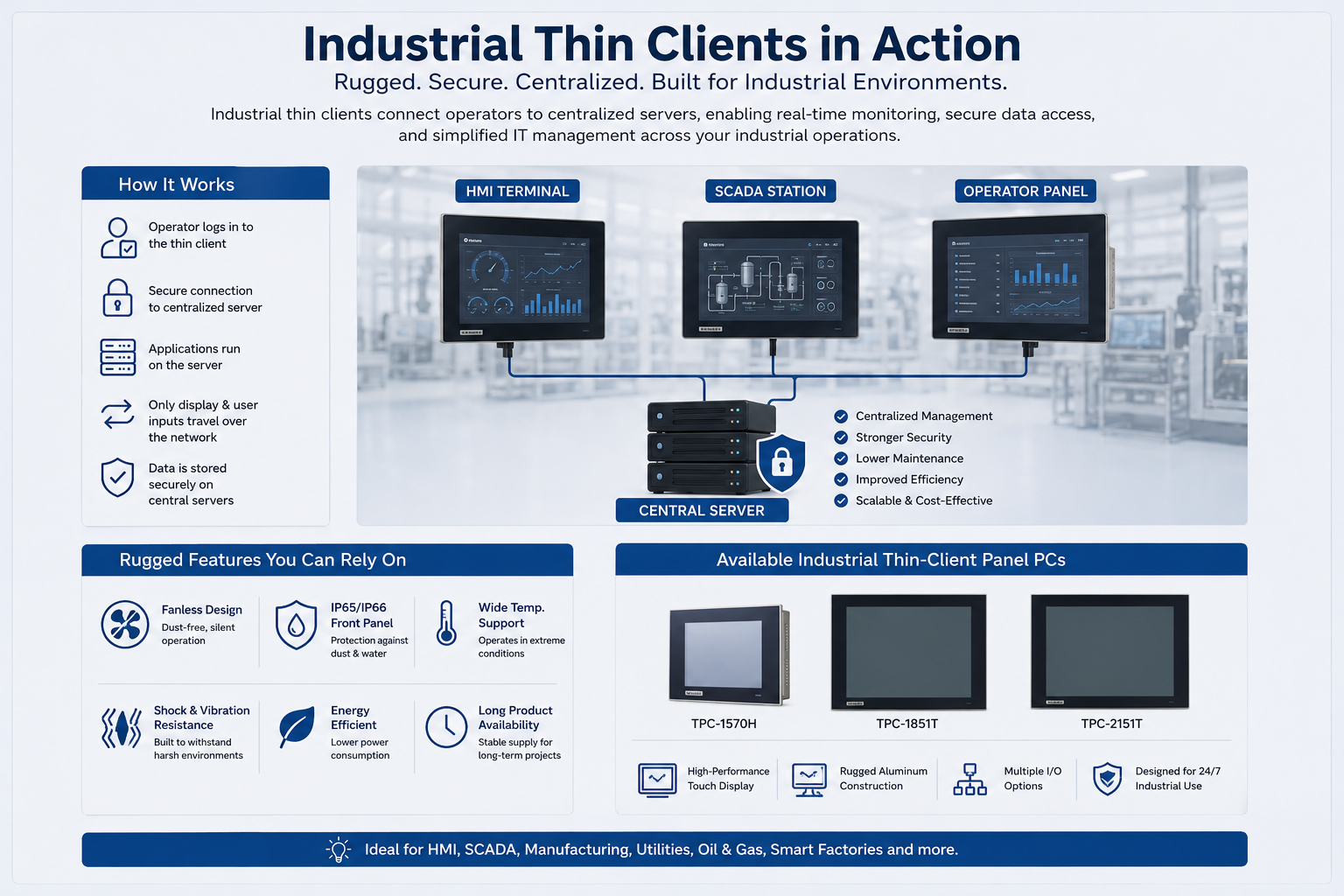
These devices communicate with centralized servers through secure network connections. Applications run on the server, while the thin client displays the user interface and transmits keyboard, touchscreen, or mouse inputs.
The process is straightforward:
- The operator logs into the thin client.
- The device connects to a centralized server or virtualization platform.
- Applications execute remotely.
- Only display information and user interactions are transmitted over the network.
- Data remains securely stored on central servers.
Because software updates, backups, and security patches are managed centrally, IT teams can maintain hundreds of workstations far more efficiently than with traditional industrial PCs.
Key Features of Industrial Thin Clients
These rugged systems are purpose-built for environments where reliability, uptime, and easy maintenance are essential.
Rugged Industrial Design
Industrial facilities expose equipment to dust, vibration, humidity, and extreme temperatures. Rugged construction, industrial-grade components, and IP-rated front panels help thin clients deliver reliable performance even under demanding operating conditions.
Fanless and Energy Efficient
Most rugged thin-client terminals use passive cooling instead of mechanical fans. This reduces dust buildup, eliminates a common point of failure, lowers power consumption, and extends hardware lifespan.
Centralized Management
One of the biggest advantages of these systems is simplified administration. IT teams can remotely deploy software updates, monitor device health, configure settings, and manage user access from a centralized platform, reducing onsite maintenance and improving operational efficiency.
Enhanced Security
With minimal local storage and centralized authentication, Thin-client deployments reduce the risk of data loss and unauthorized access. Security updates can also be deployed consistently across all connected devices.
Industrial Thin Client vs. Industrial PC
Choosing between an industrial thin client and a traditional industrial PC depends on your operational requirements.If your facility operates multiple production lines or distributed workstations, these rugged terminals provide greater efficiency and lower long-term operating costs.
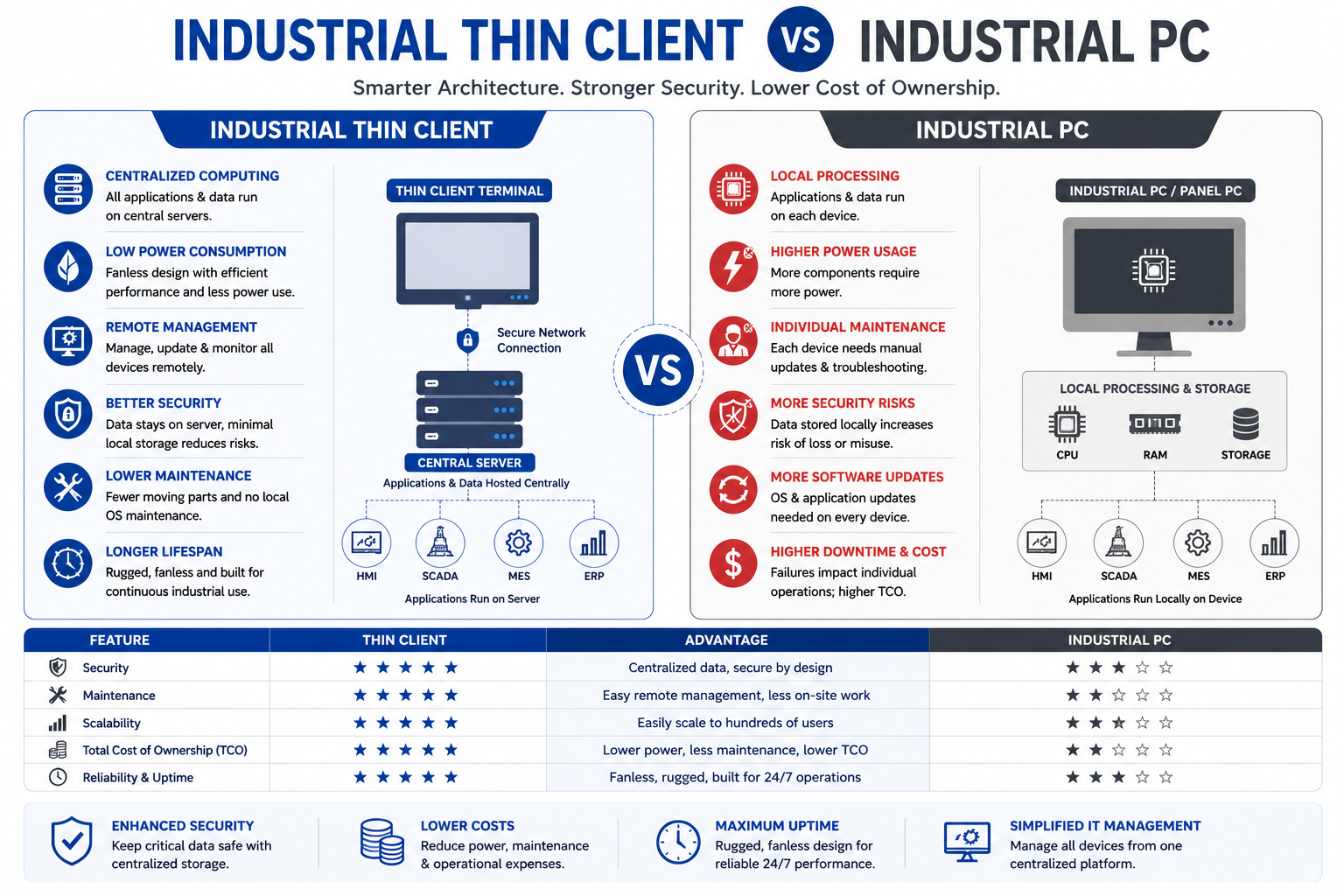
While both industrial thin clients and industrial PCs are designed for rugged environments, they differ significantly in how they process applications and manage data. Thin clients rely on centralized servers for computing, making them easier to secure, update, and manage across multiple workstations. Industrial PCs, on the other hand, perform all processing locally, making them suitable for applications that require high-performance standalone computing. The right choice depends on your operational requirements, IT infrastructure, and long-term maintenance strategy.
Why Thin-Client Technology Is Ideal for Modern Automation
Industrial environments demand reliable computing solutions capable of operating continuously under challenging conditions. Consumer-grade devices often fail due to dust, vibration, heat, or mechanical wear.
These industrial terminals are specifically engineered to overcome these challenges while supporting modern automation technologies such as Industry 4.0, Industrial IoT (IIoT), remote monitoring, and predictive maintenance.
They help organizations:
- Improve operational uptime
- Simplify IT infrastructure
- Reduce maintenance costs
- Strengthen cybersecurity
- Support digital transformation initiatives
As automation systems become increasingly connected, centralized computing offers businesses a scalable and future-ready infrastructure.
Applications in Industrial Automation
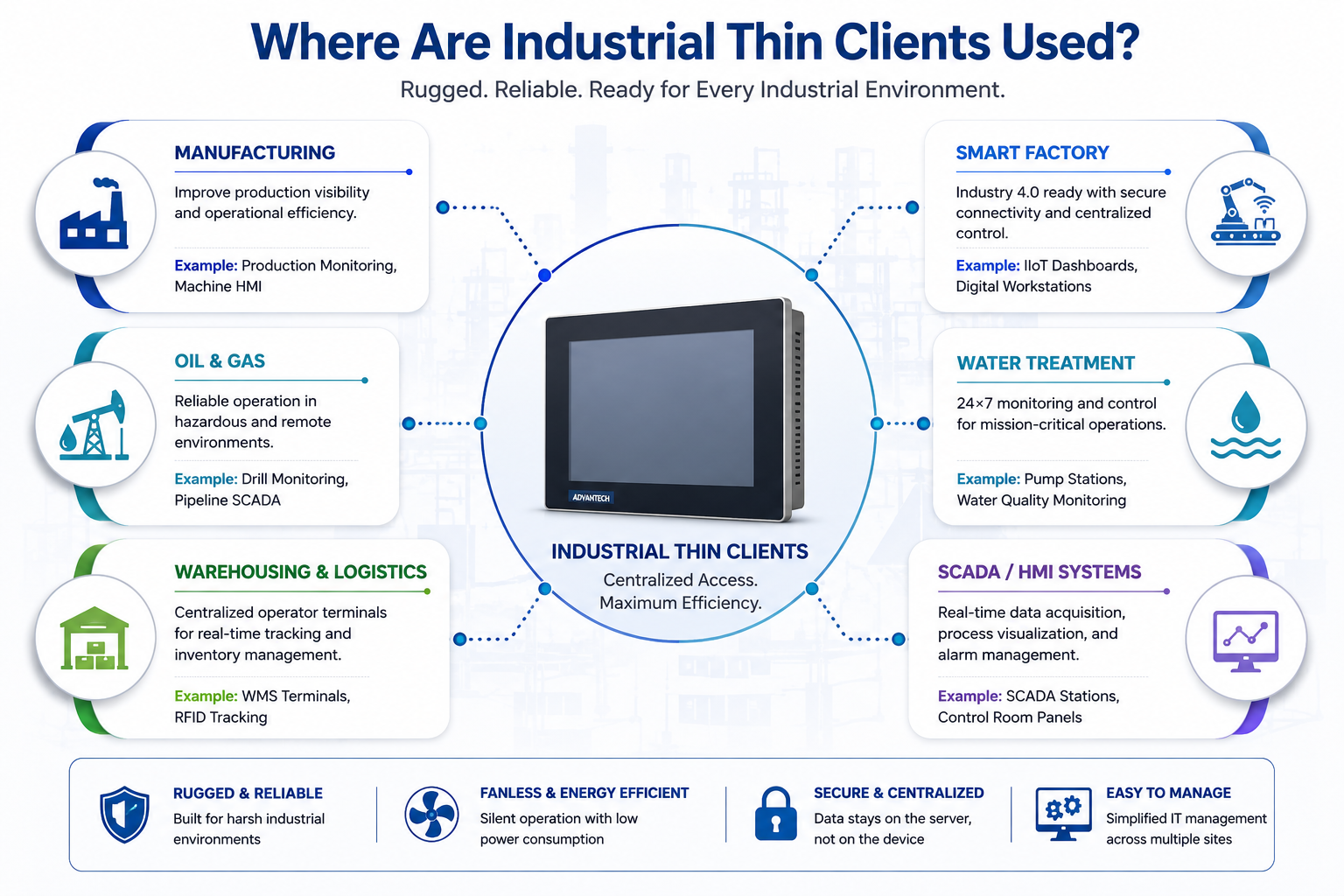
Thin client solutions are used across a wide range of industries where centralized control and reliable operation are essential.
Human Machine Interface (HMI)
HMI systems allow operators to monitor machinery, view production data, and control industrial equipment. These rugged terminals provide secure access to centralized HMI applications, ensuring consistent interfaces while reducing workstation maintenance.
SCADA Systems
SCADA environments require continuous monitoring of production equipment, PLCs, sensors, alarms, and process variables. These rugged terminals deliver secure access to centralized SCADA platforms while simplifying software management and improving system security.
Manufacturing and Smart Factories
Modern manufacturing facilities use thin-client systems to standardize operator workstations, support automation systems, reduce hardware failures, and improve production visibility. Their centralized architecture aligns perfectly with Industry 4.0 initiatives.
Other Industrial Applications
These solutions are also widely deployed in:
- Oil & gas facilities
- Water and wastewater treatment plants
- Food & beverage manufacturing
- Pharmaceutical production
- Logistics and warehousing
- Energy and utilities
Their rugged design and reliable operation make them suitable for environments where continuous uptime is critical.
Benefits of Using Industrial Thin Clients
Modern thin-client systems offer more than just an alternative to traditional industrial PCs—they provide a smarter way to manage industrial computing infrastructure. By centralizing applications and data, businesses can improve operational efficiency while reducing hardware-related challenges.
Lower Total Cost of Ownership (TCO)
One of the biggest advantages of a thin client solution is the reduction in long-term operational costs. Since applications run on centralized servers, organizations spend less on maintaining individual workstations.
Key cost-saving benefits include:
- Reduced hardware maintenance
- Lower energy consumption
- Longer equipment lifespan
- Simplified software deployment
- Fewer on-site service visits
For facilities operating hundreds of workstations, these savings can significantly improve return on investment over time.
Enhanced Cybersecurity
As industrial networks become increasingly connected, cybersecurity has become a top priority. These centralized computing devices improve security by minimizing local storage and centralizing authentication and software management.
This helps organizations:
- Protect sensitive operational data
- Simplify security updates
- Reduce attack surfaces
- Enable secure remote access
- Maintain compliance with cybersecurity best practices
Improved Reliability and Uptime
These fanless industrial terminals are built for continuous operation in demanding environments. Their fanless architecture eliminates one of the most common hardware failure points, while rugged industrial components ensure reliable performance even in dusty, humid, or high-vibration environments.
The result is:
- Reduced downtime
- Lower failure rates
- Consistent system performance
- Longer hardware lifecycle
Simplified IT Management
Instead of configuring and maintaining each workstation individually, administrators can manage all connected thin clients from a centralized platform. Software updates, system configurations, and troubleshooting can often be performed remotely, reducing maintenance efforts and minimizing production interruptions.
How to Choose the Right Industrial Thin Client
Selecting the right thin client solution depends on your application, operating environment, and future scalability requirements. Here are the key factors to evaluate before making a decision.
1. Operating Environment
Choose a device designed for your industrial conditions. Look for features such as:
- IP65/IP66 front protection
- Fanless cooling
- Wide operating temperature support
- Shock and vibration resistance
- Rugged industrial construction
These specifications help ensure reliable performance in harsh environments.
2. Display Size and Interface
Different applications require different display configurations. Compact HMIs may only need smaller displays, while control rooms often benefit from larger touchscreen interfaces that improve operator visibility and ease of use.
3. Connectivity
Industrial automation systems rely on multiple communication interfaces. Ensure the thin client supports the connectivity your infrastructure requires, including:
- Gigabit Ethernet
- USB connectivity
- Serial ports
- Multiple display outputs
- Industrial networking compatibility
4. Remote Management Support
A major advantage of these solutions is centralized administration. Selecting devices that support enterprise management platforms allows IT teams to deploy updates, monitor device health, and manage users efficiently from a central location.
5. Product Lifecycle and Vendor Support
Industrial automation projects often remain operational for many years. Choosing solutions from established manufacturers ensures long-term availability, technical support, and compatibility with future system upgrades.
Advantech Thin Client Solutions from ITG India
As an authorized distributor of Advantech Industrial Automation Solutions, ITG India provides a comprehensive range of thin clients designed for HMI, SCADA, and factory automation applications. These rugged devices combine high reliability, centralized management, and industrial-grade performance to support modern automation environments.
Some of the featured solutions include:
Advantech TPC-1251T
A compact 12-inch rugged thin-client terminal featuring fanless operation, an IP66-rated front panel, and reliable performance for HMI applications in demanding industrial environments.
Advantech TPC-1551T
Designed for larger operator interfaces, the Advantech TPC-1551T offers a 15-inch touchscreen, rugged construction, and reliable performance for demanding factory environments.
Advantech TPC-651T
Ideal for space-constrained installations, the TPC-651T combines a compact footprint with dependable fanless performance for industrial monitoring applications.
Whether you’re upgrading an existing automation system or implementing a new HMI or SCADA infrastructure, ITG India can help you identify the right Advantech Industrial Thin Client for your operational requirements. Learn more about SCADA system architecture to understand how centralized computing enhances industrial automation.
Conclusion
Thin-client technology has become an essential component of modern industrial automation by combining centralized computing with rugged, reliable hardware. Compared to traditional industrial PCs, they offer simplified management, stronger cybersecurity, lower maintenance costs, improved scalabilaity, and better long-term value.
As industries continue adopting Industry 4.0, IIoT, and smart manufacturing technologies, These centralized computing solutions provide the flexibility and reliability needed to support centralized HMI and SCADA systems while reducing operational complexity.
With ITG India’s portfolio of Advantech Thin Client Solutions, businesses gain access to trusted automation solutions designed for demanding industrial applications. From compact HMI terminals to modular computing platforms, these solutions help organizations build secure, scalable, and future-ready automation systems.